


Mobile apps for housekeepers: what they are and how to use them to gain control and availability
The mobile applications for housekeeping staff are tools that allow you to manage room status, cleaning tasks, daily priorities and incidents from your mobile phone, connecting the work of the floors with reception and, ideally, with the PMS. In a small hotel, their value is not in “digitising for the sake of modernisation”, but in reducing downtime, errors and internal friction: fewer calls, less improvised WhatsApp and fewer rooms “ready” that nobody sees on time.
When the app is integrated with the PMS, the hotel works with a single source of truth: check-ins, check-outs and status changes are synchronised and visible to all teams. This coordination translates into operational control and, in many cases, more saleable availability (rooms ready earlier, fewer blockages and better ability to respond to emergencies).
From our position as a technology provider in the industry, we experience first-hand the challenges faced by hoteliers and how a modern management system can make a difference. The evolution of the Hotel PMS has evolved from a control tool to a strategic driver of efficiency, personalisation and data-driven decision making.
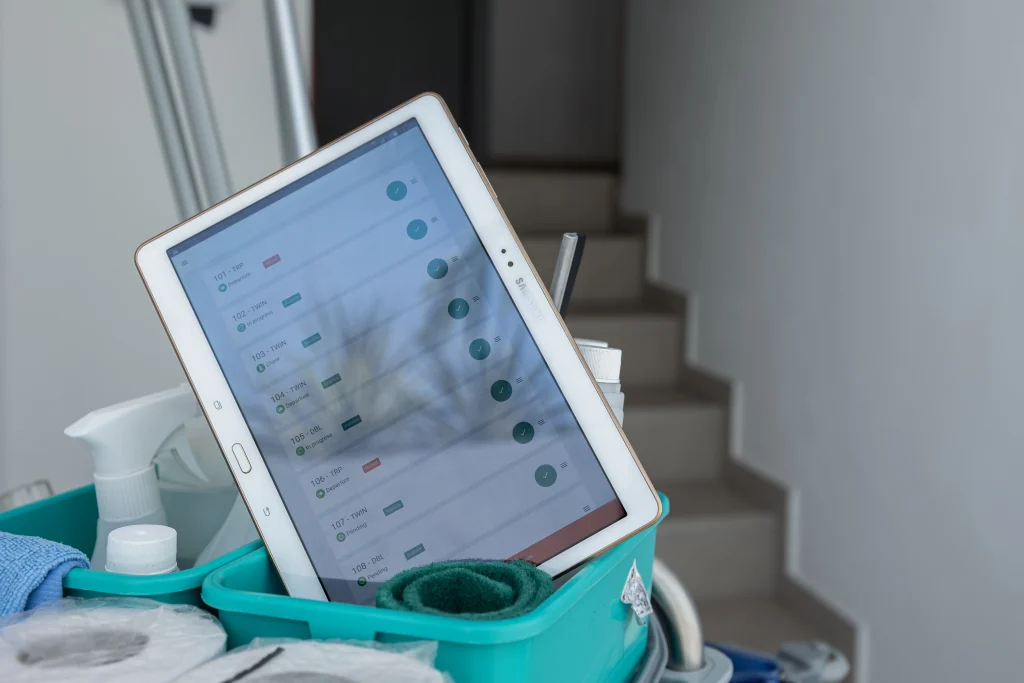
Why a mobile housekeeping app changes the day-to-day life of a small hotel
In small hotels, the housekeeping department often works with “quick” tools (paper, WhatsApp, calls) that solve the day, but generate recurring problems:
- States of habitation outdatedreception thinks a room is ready when it is not (or the other way around).
- Mismanaged priorities: “easy” is cleared before urgent arrivals.
- Room delays and stress at peak times: early arrivals, groups and weekends.
- Reception-floor conflicts due to lack of traceability (“I warned”, “I didn't get it”).
- Incidents without follow-up: late maintenance, rooms blocked for longer than necessary.
The impact is not only internal. It is noticeable in availability, in the guest experience (waits, room changes, complaints) and in the hotel's ability to sell with criteria (rotation, early check-in, minimising “walk-aways” due to lack of ready rooms).
What a housekeeping app should solve (key use cases)
A housekeeping mobile app should at least cover these use cases:
- Update statuses (dirty/clean/inspected/out of order).
- Assign rooms and tasks per person/shift and monitor progress.
- Structured communication with reception (priorities, urgencies, changes).
- Incident management and maintenance, with registration and monitoring.
- Time control and workload to balance the shift.
- Arrival preparation (VIP, requests, early check-in).
- Prioritisation by urgency (departures, arrivals, key rooms).
The important thing is that these functions reduce duplicated work and give real-time visibility, not add steps.
- States of habitation outdatedreception thinks a room is ready when it is not (or the other way around).
- Mismanaged priorities: “easy” is cleared before urgent arrivals.
- Room delays and stress at peak times: early arrivals, groups and weekends.
- Reception-floor conflicts due to lack of traceability (“I warned”, “I didn't get it”).
- Incidents without follow-up: late maintenance, rooms blocked for longer than necessary.
The impact is not only internal. It is noticeable in availability, in the guest experience (waits, room changes, complaints) and in the hotel's ability to sell with criteria (rotation, early check-in, minimising “walk-aways” due to lack of ready rooms).
Recommended minimum flow: from check-out to “room ready”.”
A simple and effective flow usually looks like this:
- The check-out in the PMS.
- The room status automatically changes to “pending/dirty” and generates homework.
- The task is assigned to a waitress/supervisor according to priorities.
- Cleaning is carried out and marked “clean” (or “in progress” if the flow supports it).
- Inspection/review is done and marked “lista/inspected”.
- Reception sees the room as available in real time and can assign it or confirm early check-in.
The practical difference is the real timeAvoid calls and waits, and reduce errors of “room ready” that is not registered or “room occupied” that has already been checked out.
Must-have features in mobile applications for housekeeping staff
Rather than a list of features, each function should be evaluated for the problem it avoids and the improvement it enables.
Native integration with PMS (synchronisation with check-ins, check-outs and statuses)
Native integration is critical because it eliminates double handling: if housekeeping works in an app and reception in the PMS without real synchronisation, discrepancies arise. With synchronisation of check-ins, check-outs and room status, The changes are automatically updated and the equipment stops “translating” information between systems.
Real-time update between reception and floors
The value of real time is seen in the day-to-day: reception sees actual progress, housekeeping is aware of emergencies and calls are reduced. Typical example: early arrival; reception prioritises a specific room and floors see it instantly, no message chains.
Global operational dashboard of hotel status
A useful dashboard should at least show:
- rooms by status (dirty/clean/inspected/OOO),
- assigned/in progress/pending inspection,
- open incidents and their priority,
- load per employee/shift (for supervision).
This allows decisions to be made without chasing information: rebalancing tasks, prioritising arrivals and detecting bottlenecks.
Intelligent task allocation and prioritisation by urgency
In a small hotel, “smart” must mean simple and adjustableBalanced allocation, priority by departures and arrivals, VIP, early check-in, and zone/time balance. A useful app helps to avoid one person being overloaded while another finishes first, and to ensure that urgent matters are dealt with first.
Incident management with photos and traceability
Photos and structured registration improve two things: coordination and accountability. They are used for damage, missing items, maintenance, special cleaning or replacement. Traceability avoids internal conflicts (“I didn't see it”, “it wasn't reported”) and facilitates preventive maintenance: the incident remains open until it is closed, with history.
Customised roles and permissions for control and monitoring
Roles allow each profile to see what it needs to see:
- waitress: assigned tasks and status,
- supervisor: assignment, inspections, dashboard,
- reception: visibility of states and emergencies,
- maintenance: assigned incidents.
This reduces errors due to unauthorised changes and improves control without bureaucracy.
Automatic reporting and KPIs (productivity and load forecasting)
Useful KPIs are usually operational, not “pretty”:
- times per room and per typology,
- rooms per employee/shift,
- pending by time slot,
- incidents per room and resolution time,
- compliance with standards (if inspections are carried out).
In smaller hotels, it is practical that reports can be exported to Excel/PDF for simple analysis and follow-up with direction.
Elimination of paper and reduction of manual errors
Paper fails in the same old ways: out-of-date statuses, duplications, lost sheets and zero traceability. Digitisation is not posturing; it is reliability. If the “ready” status is recorded on the spot, reception acts with certainty and errors that cost time and reputation are reduced.
Direct impact on revenue: room turnover and saleable availability
Housekeeping is not just about “quality”: it's about availability. Less turnover time means more rooms ready earlier, fewer blocked rooms and better ability to sell in peaks. This is especially noticeable in:
- early check-in (when the hotel can offer it because it actually has rooms ready),
- reduction of walk-aways due to lack of operational availability even if there are exits,
- better response to last minute changes and groups,
- fewer “rooms out of order” for incidents that drag on without follow-up.
It is not about promising figures, but about understanding the chain: real-time information → faster decisions → rooms ready sooner → more reliable saleable availability.
Metrics to demonstrate improvement (without relying on advanced tools)
A small hotel can measure impact with simple metrics:
- average turnover time (check-out to “ready”),
- % of rooms ready before a target time,
- incidents per room and resolution time,
- number of rooms out of service and accumulated days,
- cleanliness/condition complaints,
- response times to emergencies (early arrivals).
- early check-in (when the hotel can offer it because it actually has rooms ready),
- reduction of walk-aways due to lack of operational availability even if there are exits,
- better response to last minute changes and groups,
- fewer “rooms out of order” for incidents that drag on without follow-up.
It is not about promising figures, but about understanding the chain: real-time information → faster decisions → rooms ready sooner → more reliable saleable availability.
How to choose a housekeeping app for your hotel (decision checklist)
Practical checklist to help you decide without getting lost:
- PMS integration real (check-outs, check-ins, status, typologies).
- Real-time and cross-reception-floor visibility.
- Operational dashboard with status, pending and incidents.
- Allocation and priorities (departures, arrivals, VIPs, emergencies).
- Incidents with photos and closure flow.
- Roles and permissions per profile.
- Reports and export (Excel/PDF).
- Ease of use (simple interface, few clicks, languages).
- Support and training (especially in start-up).
- Total cost (licences, devices if applicable, implementation).
A good practice is to ask for a demo with real hotel scenarios: early arrivals, room change, photo incident, and an inspection.
Questions to ask in a demo
- How do you synchronise check-outs/check-ins and room statuses with the PMS?
- What happens if the connection drops, is work lost or is it synchronised afterwards?
- Can I prioritise by arrivals and reception urgencies?
- How are incidents recorded with photos and who sees them?
- What roles are there and what can each do?
- How do I export KPIs and reports? Can I see productivity per shift?
Implementation in a small hotel: a 2-week plan for real use
In small hotels, success depends on adoption. A realistic two-week plan might be:
- Days 1-3The following are some of the main functions: configuration (typologies, statuses, flows), definition of roles and permissions, and loading of users.
- Days 4-6Pilot in one shift or plant (few people, real cases), with daily adjustments.
- Week 2: progressive deployment to the whole team, micro-training at the workstation and establishment of routines (status update, inspection, incident closure).
The aim is for the app to be “the way you work”, not an additional layer.
Common mistakes when implementing housekeeping apps
- Not defining clear states (everyone marks what they want).
- Duplicate systems (app + paper + WhatsApp) without transition.
- Do not train supervision (without leadership, use falls).
- Do not set update and inspection routines.
- Do not measure KPIs or review incidents.
- Start with too much complexity (more fields and steps than necessary).
How a Housekeeping App integrated with PMS improves guest experience
When housekeeping and front desk work in sync, guests notice it in concrete ways: rooms ready on time, less waiting on arrival, fewer assignment errors and faster response to incidents. In addition, traceability reduces internal misunderstandings that would otherwise end up affecting the hotel's service and reputation.
Frequently asked questions about mobile applications for housekeeping staff
What is a housekeeping app in a hotel?
It is a mobile tool to manage room status, cleaning tasks and incidents, connecting the work of floors with reception and, ideally, with the PMS. Its function is to coordinate in real time what is pending, what is in progress and what is ready, with traceability and prioritisation.
Why is it important for the app to be integrated with the PMS?
Because it allows automatic synchronisation with check-ins, check-outs and room status, avoiding double check-ins and discrepancies between departments. When PMS and housekeeping share a single source of truth, it reduces errors, calls and rooms “listed” as unavailable, improving operation and control.
Which functions are essential in small hotels?
These typically include: real-time updates, assignment and prioritisation, status dashboard, incidents with photos, roles and permissions, and reports with export. In small hotels, ease of use is also critical: if the app requires too many steps, adoption drops and they revert to WhatsApp or paper.
How does a housekeeping app help to increase availability and revenue?
It reduces turnaround times and improves coordination to prioritise urgent rooms, which increases the number of rooms ready at key times. It also helps reduce blocked rooms due to untracked incidents. With more reliable operational availability, the hotel loses fewer sales due to “not having ready” a room that, in reality, could already be ready.
What KPIs can I draw from to measure team productivity?
The most useful are: time per room, rooms per employee/shift, pending by time slot, incidents per room and resolution time, and compliance with standards if there is inspection. For smaller hotels, it is useful to be able to export to Excel/PDF and review weekly trends, not just daily data.
How long does it take to implement a housekeeping app?
It depends on the size of the hotel and the cultural change, but can range from a few days to a few weeks. A prudent approach is to start with a short pilot per shift or floor, adjust the flow and then roll out progressively. The real speed is in the adoption: if the team is using it from day one, the rollout is accelerated.
How do I reduce errors and conflicts between reception and housekeeping?
With three pillars: real time, traceability and roles. If reception sees the actual status and housekeeping receives clear priorities, calls and misunderstandings are reduced. Incident management with photos and records avoids discussions about “what happened” and makes it easier for housekeeping to act with complete information and close the loop.
You may also be interested in


REQUEST YOUR DEMO TODAY
Discover how Lean Hotel System can transform your hotel business