


Timeshare hotel management: challenges, solutions and the future of the model
Timeshare management in hotel software describes the ability of a hotel to PMS (Property Management System) to administer several hotels or establishments from a single centralised platform. This model responds to the need for hotel chains to unify processes, guarantee quality standards and have real-time corporate visibility on the performance of each property.
Unlike a traditional single-hotel PMS, a multi-property PMS concentrates critical information in a single database, with modules designed to scale from small groups to international networks.

What is timeshare management in hotel software?
A multi-property PMS:
- Centralises inventory and tariffsallowing global or customised configurations per hotel.
- Integrate bookings and channelsThe Commission has also developed a new system for the collection of data, avoiding duplication and reducing the risk of overbooking.
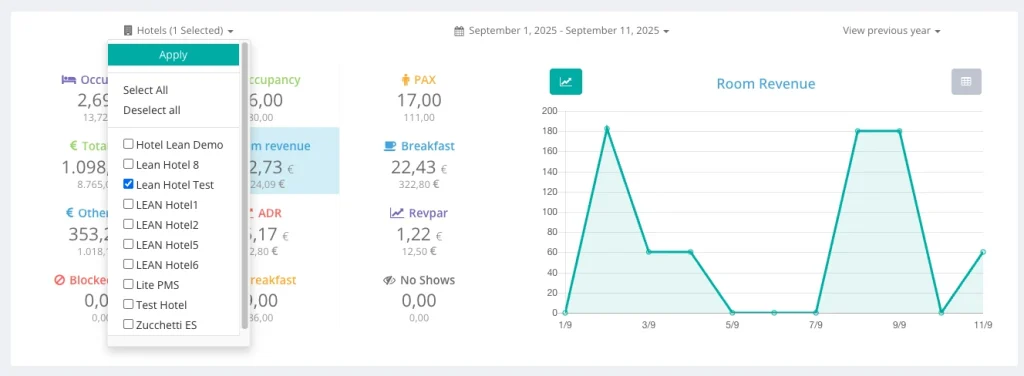
- Provides executive dashboardswith consolidated KPIs and comparisons by property.
- Segregate roles and accessThe system is adapted to the corporate hierarchy and guarantees information security.
The result is a digital ecosystem in which the daily operations of each hotel are aligned with the chain's strategy.
Challenges of timeshare management
Standardisation of tariffs and commercial policies
One of the biggest challenges is to maintain consistency in pricing, restrictions and promotions. Chains need to:
- Rate updates are propagated to all hotels instantly.
- Cancellation policies and payment guarantees are applied homogeneously.
- Discrepancies between what is published in the PMS, the CRS and the distribution channels are avoided.
For this reason, some PMSs prefer that the tariff management is done directly from the Channel Manager, as it is the system that is ultimately responsible for distributing the tariffs to all channels.
Hotel-to-hotel availability management
When distributing inventory across multiple OTAs and GDSs, the synchronisation must be fine-tuned to the millimetre:
- Overbooking in a hotel affects the reputation of the whole chain.
- Multi-tenancy systems must update availability in real time, even under high demand.
Accounting and tax integration
Each establishment has to keep its own accounts, but the parent company needs consolidation:
- Hotel and global balances in the same environment.
- Tax automation according to different jurisdictions.
- Comparative reports to assess margins and detect inefficiencies.
Security and access control
With multiple users in different hotels, permissions management is critical:
- Segmented roles (corporate, management, reception, housekeeping).
- Restrictions by property and by function.
- Audit trails for full traceability of actions.
Scalability
A timeshare PMS should respond equally well to 5 hotels or 200 hotels:
- Cloud-native architecture to support peak loads.
- Optimisation of large database queries.
- Redundancy and automatic backups for operational continuity.
Current technological solutions
Multi-property PMS: the core of centralised management
📌 Global settings of tariffs, users, meal plans and customer profiles, applicable throughout the network.
📌 Replication of templates on opening new hotels, reducing implementation times.
📌 Corporate dashboards that consolidate KPIs such as occupancy, ADR, RevPAR or GOPPAR in real time.
📌Role management and hierarchical permissions, with clear separation between corporate and local.
📌 Native integration with accounting and invoicing to consolidate results globally.
CRS integrated with PMS
The Central Reservation System is not a separate module, but an extension of the PMS:
- Manage direct bookings on the corporate website.
- Synchronise inventory in OTA's and GDS in real time.
- It allows visibility of demand and consolidated pick-up, without the need for external platforms.
RMS connected to PMS
The Revenue Management System reaches its full potential when powered by the multi-property PMS:
- Yield and dynamic pricing models work with homogeneous data from the entire network.
- Generates comparative projections between hotels and segments.
- It offers fare recommendations integrated directly into the PMS booking engine.
Channel manager as an extension of the PMS
In a multi-tenancy environment, the channel manager functions as a gateway:
- Centralised contracts with OTAs, managed from the same PMS.
- Automatic update of quotas and rates per hotel or globally.
- Distribution cost reports accessible on the corporate dashboard.
SaaS in the cloud
The cloud architecture ensures that the multi-property PMS is scalable and secure:
- Access from any device with configurable permissions.
- Automatic updates that keep the platform up to date without interrupting operations.
- Elimination of local servers, saving on support and maintenance.
- Geographical redundancy ensuring operational continuity.
What is the future of timeshare in hotels?
The future of multi-property management in PMS points to cloud-native platforms, capable of scaling automatically and guaranteeing 24/7 availability. Artificial intelligence will boost revenue management with predictive algorithms that adjust rates in real time. In addition, systems are evolving towards full-stack integration, connecting with ERP, BI and HRM to unify finance, data and operations. Under an API-first approach, PMSs will offer open ecosystems that facilitate the addition of online check-in, digital keys or upselling tools. This requires enhanced cybersecurity, with multi-factor authentication, end-to-end encryption and continuous monitoring to protect sensitive data in multi-tenant environments.
Frequently asked questions about timeshare in PMS
What is the difference between timesharing and multi-user?
Multi-property manages multiple hotels in a PMS, whereas multi-user only defines permissions within an individual hotel.
How is the inventory of several hotels managed in a single PMS?
With centralised databases that segregate availability by establishment and synchronise with CRS and distribution channels.
What are the benefits for strategic decision-making?
Dashboards with global and hotel-specific KPIs allow you to compare performance and detect deviations immediately.
Is it scalable for small and medium sized chains?
Yes. SaaS PMSs allow you to start with just a few hotels and grow to tens or hundreds of properties without complex migrations.
How is billing managed in a timeshare PMS?
Each hotel maintains its own billing and tax obligations, but the system allows for the consolidation of results into corporate reports.
Can guest profiles be shared between hotels in the same chain?
Yes, a multi-property PMS creates a single customer database that enables loyalty and guest recognition programmes across the network.
What level of security do timeshare PMSs offer?
They include multi-factor authentication, encryption of sensitive data and traceability of access by user and establishment.
How does a multi-property PMS integrate with other systems?
Through APIs and native connectors to ERP, BI, RMS, channel managers and digital check-in solutions.
What if a hotel in the chain needs different rate rules or policies?
The multi-property PMS allows global configurations and, at the same time, property-specific exceptions.
What are the advantages of opening new hotels?
Corporate templates allow you to replicate configurations, users and tariffs, drastically reducing implementation time.
You may also be interested in


- Follow us on Linkedin and don't miss anything!
REQUEST YOUR DEMO TODAY
Discover how Lean Hotel System can transform your hotel business