


Channel manager and booking engine: what each does and why they must work connected
In a small or medium-sized hotel, it's easy to confuse tools that sound similar but serve different functions. The channel manager and the booking engine they don't do the same thing, even though both directly influence sales, availability, prices, and daily workload.
The main difference is simple: the channel manager helps distribute inventory across external channels, such as OTAs; the booking engine allows sales directly from the hotel's website. However, for them to work well, both must connect to the PMS. If each system operates independently, you'll get availability errors, inconsistent rates, duplicate bookings, and more manual work for reception and revenue management.
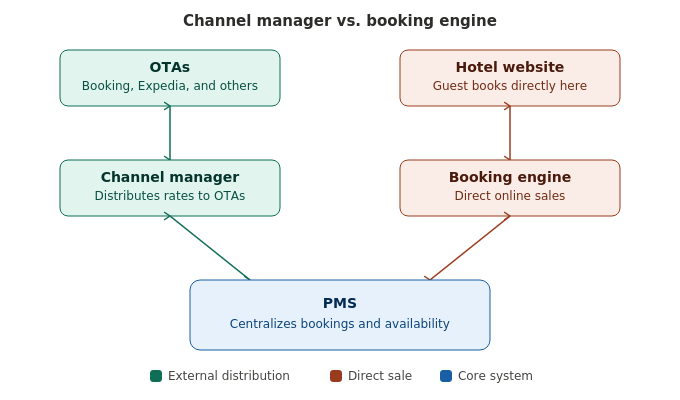
The key idea: they are not the same, but they must function as part of the same flow
A channel manager It is used to manage distribution across external channels, meaning it helps send availability, prices, and restrictions to OTAs and other sales channels. Its purpose is to prevent the hotel from having to manually log into each platform to update rates or close availability.
A booking engine, on the other hand, allows the guest to book directly from the hotel's website. Its aim is not to distribute to third parties, but to convert web visits into direct bookings.
Although their functions are distinct, they must share information with the PMS. The PMS centralises inventory, bookings and daily operations; the channel manager distributes; and the booking engine sells directly. When these components are connected, the hotel operates with less duplication and less operational risk.
A channel manager is a tool that helps hotels manage their online distribution channels. It solves the problem of overbooking and ensures that room availability is updated in real-time across all connected online travel agencies (OTAs) and the hotel's own website.
A channel manager is a tool that allows availability, rates and restrictions to be distributed across different external sales channels. For example: Booking, Expedia, online travel agents, metasearch engines if applicable, or other connected distributors.
Without a channel manager, the hotel would have to update each channel manually. This might seem manageable at first, but it becomes risky when there are multiple channels, frequent price changes, variable seasons, or high occupancy. A delay in updating availability can lead to overbooking; a wrongly charged rate can result in losses or complaints.
Un channel manager suele sincronizar la siguiente información:* **Disponibilidad:** Esto incluye el número de habitaciones disponibles para cada tipo de habitación en fechas específicas. Cuando una habitación se reserva en un canal, el channel manager actualiza automáticamente la disponibilidad en todos los demás canales conectados. * **Precios:** Los precios por noche, por tipo de habitación y para diferentes períodos (temporada alta, baja, ofertas especiales, etc.). Los cambios de precios realizados en el channel manager se reflejarán de inmediato en todos los canales. * **Restricciones:** Normas como el número mínimo o máximo de noches de estancia (length of stay), el día de llegada o salida permitido (day of week restrictions), o el tiempo de antelación para reservar (booking lead time). * **Información de la propiedad:** Detalles como el nombre del hotel, la dirección, la descripción, las comodidades, las políticas, las fotos y los tipos de habitaciones. Esta información se mantiene actualizada para asegurar la coherencia en todos los canales. * **Reservas:** Los detalles de las nuevas reservas se reciben desde los canales y se envían a tu sistema de gestión hotelera (PMS) o sistema de reservas. Esto incluye la información del huésped, las fechas de estancia, el tipo de habitación y los detalles de pago. * **Información del huésped:** En algunos casos, se pueden sincronizar datos básicos del huésped, como el nombre y el correo electrónico, para facilitar la comunicación y el check-in. * **Tarifas y ofertas:** Las promociones, paquetes o tarifas especiales que hayas configurado en tu channel manager se pueden distribuir a los canales a través de él.
A channel manager typically synchronises key information such as availability, prices, restrictions, close sales, minimum stays, policies, and bookings received. It can also manage modifications and cancellations depending on the integration.
The quality of this synchronisation is critical. If availability is not updated on time, the hotel could sell rooms it no longer has. If rates do not synchronise correctly, different prices may appear across channels.
A good channel manager avoids:* **Overselling:** Double-booking rooms or inventory across different platforms. * **Under-selling:** Having rooms available that aren't listed on all channels due to manual updates or errors. * **Rate Parity Issues:** Listing different prices for the same room on different channels. * **Incorrect Inventory Updates:** Not reflecting real-time availability changes immediately on all connected platforms. * **Manual Data Entry Errors:** Mistakes made when manually updating rates, availability, or reservations. * **Lost Reservations:** Failing to receive or acknowledge bookings from certain channels. * **Poor Guest Experience:** Caused by overbooking, incorrect room types, or communication breakdowns. * **Missed Revenue Opportunities:** Due to not optimising pricing or availability across all channels. * **Inconsistent Branding and Information:** Presenting different descriptions or policies for the same property across platforms. * **Channel Inefficiencies:** Spending too much time on manual updates instead of strategic tasks.
A well-connected channel manager helps to avoid common problems:
- Overbooking due to outdated availability.
- Different rates between channels.
- Sales closures that do not apply.
- Repeated manual changes.
- Bookings not arriving correctly at the PMS.
- Errors due to having to enter each OTA one by one.
Its main value is not just to sell more, but to sell with more control.
What is a booking engine and why is it key to direct sales
The booking engine is the system that allows guests to book from the hotel's website. It's not just a form: it's a key part of the direct sales strategy.
A good booking engine should be clear, fast, responsive, and consistent with the hotel's rates, availability, and conditions. If a user visits the website, finds the price, understands what the booking includes, and can complete the process without any issues, the hotel gains an opportunity for direct sales without relying so heavily on external commissions.
Furthermore, direct bookings usually give more control over the guest relationship: data, pre-arrival communication, extras, policies, and future loyalty actions.
A booking engine must have several key features to improve conversions:* **User-friendly interface:** It should be intuitive, easy to navigate, and visually appealing, allowing users to find and book rooms quickly and without hassle. * **Fast loading speed:** Slow loading times are a major conversion killer. The engine must be optimised for speed on all devices. * **Mobile responsiveness:** A significant portion of bookings are made on mobile devices. The booking engine must adapt seamlessly to different screen sizes. * **Clear and attractive visuals:** High-quality photos and videos of rooms and hotel amenities are crucial for enticing potential guests. * **Transparent pricing and inclusions:** All costs, taxes, and what's included (e.g., breakfast, Wi-Fi) should be clearly displayed upfront. Avoid hidden fees. * **Real-time availability:** Accurate, up-to-the-minute room availability is essential to prevent disappointment. * **Simple and secure booking process:** The fewer steps involved in booking, the better. A streamlined checkout process with multiple secure payment options instills confidence. * **Promotional capabilities:** Options to display special offers, packages, and discounts can encourage bookings. * **Upselling and cross-selling opportunities:** The ability to offer upgrades, add-ons (like spa treatments or airport transfers), and room packages at the right moment can increase revenue. * **Personalisation:** Features like displaying past stays, remembering guest preferences, or offering tailored deals can enhance the user experience. * **Trust signals:** Displaying security badges, customer testimonials, awards, and a clear privacy policy can build trust. * **Multi-language and multi-currency support:** Essential for international tourism, catering to a wider audience. * **An effective call to action (CTA):** Clear, prominent buttons like "Book Now" or "Check Availability" guide the user through the process. * **Integration with other systems:** Seamless integration with your Property Management System (PMS), Channel Manager, and CRM ensures accuracy and efficiency. * **Customer support:** Easy access to help, whether through a FAQ section, live chat, or contact details, can resolve doubts and prevent abandonment.
An effective booking engine should include:
- Clear availability by dates.
- Final prices, transparent.
- Visible policies before booking.
- Simple room selection.
- Extras apply.
- Clear payment methods.
- Automatic confirmation.
- Good mobile experience.
The guest shouldn't have to “interpret” the booking. The clearer the process, the less abandonment and fewer subsequent doubts.
Common errors in hotel booking engines
The most common failures tend to be related to friction and lack of trust: slow loading, too many steps, unclear conditions, poor mobile version, prices not matching OTAs, or incorrect availability.
It's also common for the platform not to properly explain what each rate or room includes. This can lead to people abandoning their booking before completing it or complaints afterwards, when the guest discovers conditions they hadn't understood.
How they connect to the PMS: the ideal booking flow
The ideal flow is simple: the PMS centralises inventory and bookings; the channel manager distributes availability and rates across external channels; the booking engine sells from the hotel's website; and all bookings return to the PMS to manage check-in, payments, rooms and guest communication.
When this flow is well integrated, the hotel does not need to copy data, manually close availability, or check each channel separately. Information travels between systems, and the team works with a single operational base.
Example of direct booking flow
The guest enters the hotel's website, checks availability, and books via the engine. That reservation is entered into the PMS, availability is updated, and subsequent processes are triggered: confirmation, arrival preparation, pre check-in, or payments if applicable.
The advantage is that the hotel has better control over the experience from the first contact and avoids relying solely on third parties.
Example of a flow with booking from OTA
The guest books on an OTA. The booking goes through the channel manager and arrives at the PMS. Upon entry, the availability is updated so that the remaining channels do not continue selling a room that is already occupied.
This flow is especially important when the hotel sells on multiple channels simultaneously. If the update fails or is late, the risk of overbooking increases.
Why integrating a PMS, channel manager, and booking engine reduces errors
The problem isn't having multiple tools. The problem is that they don't share information reliably. When the PMS, channel manager, and booking engine aren't well integrated, daily errors appear: manually updated rates, late-arriving bookings, rooms sold twice, or different conditions depending on the channel.
A good integration reduces manual work and improves consistency. Revenue works with more controlled rates, reception receives cleaner bookings, and the guest finds more consistent conditions.
What absolutely must be synchronised to avoid problems
At a minimum, they should synchronise:
- Fees.
- Availability.
- Restrictions.
- Bookings.
- Cancellations.
- Modifications.
- Taxes.
- Policies.
- Room types.
If any of these elements are managed manually or become misaligned, the operational risk increases.
Direct sales vs OTAs: what role does each tool play
OTAs are not enemies. They provide visibility, demand, and a presence in markets where the hotel might not reach alone. However, they also come with intermediation costs and less control over the guest relationship.
The booking engine helps to reinforce direct sales from the hotel's website. The channel manager, on the other hand, allows for better control of external distribution. The strategy should not be “direct only” or “OTAs only”, but balance: visibility, acquisition cost, and customer control.
The motor of reservations should be reinforced when it is performing poorly and not generating enough bookings. This can be due to several factors, such as a poor user experience, a lack of functionality, or outdated design.
It makes sense to reinforce it when the hotel relies heavily on OTAs, receives web traffic but converts little, runs brand campaigns, has repeat guests, or wants to offer exclusive advantages on the website.
It is also worth reviewing if the user abandons before booking, if the mobile process is inconvenient, or if the prices are unclear compared to other channels.
When a channel manager becomes indispensable
The channel manager becomes indispensable when the hotel is present on multiple OTAs, changes rates frequently, has variable seasons, works with various room types, or starts to run the risk of overbooking.
Manual management may work in a very small context with few changes, but it ceases to be viable when the distribution grows.
Common errors when configuring a channel manager and booking engine
Configuration errors typically appear at very specific points: incorrectly mapped room types, duplicate rates, different policies, incorrectly configured taxes, the engine being disconnected from real inventory, unreviewed test bookings, or a neglected mobile version.
The result can be both commercial and operational: the guest buys something that does not match what reception sees in the PMS.
Critical error: Do not align names and conditions between PMS, engine and OTAs
If a room is called one thing in the PMS, another in the engine, and a third on the OTA, the guest may get confused and reception will have more work explaining the differences.
The same applies to conditions: breakfast included, cancellation, view, maximum occupancy, taxes or extras. If each channel communicates them in a different way, complaints increase and so does the feeling of a lack of transparency.
Minimum tests before activating integration
Before activating an integration, it's advisable to test:
- Direct booking from the website.
- Reservation from OTA.
- Reservation modification.
- Cancellation.
- Restricted fare.
- Availability by room type.
- Confirmation received by guest.
- Correct booking entry in the PMS.
It is not enough to check that it “connects”. Real cases must be validated.
What to check each week to ensure everything is still working
An integration can work today and fail after a change in fare, season or promotion. That's why a light weekly routine is advisable:
- Compare availability on PMS, the web, and OTAs.
- Review prices on key dates.
- Validate active restrictions.
- Detect errors in bookings.
- Check for cancellations and modifications.
- Make a booking for a periodic test.
It's not about reviewing everything every day, but about detecting mismatches before they reach the guest.
How to choose a PMS that connects well with a channel manager and booking engine
When choosing or changing tools, the PMS should act as the operational core. If the PMS does not integrate well, the hotel will end up duplicating work between systems.
Useful criteria for evaluating:
- Bidirectional integration.
- Real-time or frequent adequate updates.
- Clear support.
- Ease of setup.
- Centralised fare management.
- Change traceability.
- Compatibility with the current engine and channel manager.
A PMS like LEAN should function as the core: centralising reservations, availability, rates and operations so that distribution and direct sales work without duplication.
Frequently Asked Questions about Channel Manager and Booking Engine
What is the difference between a channel manager and a booking engine?
The channel manager handles availability, rates, and restrictions on external channels like OTAs. The booking engine allows direct sales from the hotel's website. One helps with better distribution; the other helps convert direct traffic. Both must connect with the PMS to avoid duplication and errors.
Do I need a channel manager if I only sell on Booking.com?
If you only sell through one channel and barely change prices, it might not be essential at first. But it becomes very useful when you work with multiple channels, make frequent changes, have variable seasons, or there's a risk of overselling. The channel manager reduces manual work and availability errors.
Do I need a booking engine if I'm already on OTAs?
It can indeed be recommendable. OTAs provide visibility, but a booking engine allows you to capture direct sales from your website, reduce commission dependency, and better control the relationship with the guest. If you have website traffic or repeat guests, not having a booking engine could mean you lose out on direct reservations.
Why is it important to connect both tools with the PMS?
Because the PMS must centralise reservations, availability, rates and daily operations. If the channel manager, the engine and the PMS do not share data, duplication appears: outdated availability, different prices, late bookings or inconsistent conditions. Integration reduces manual work and errors.
What errors often appear if the booking engine is not configured correctly?
The most common issues are inconsistent pricing, incorrect availability, unclear policies, too many steps, poor mobile experience, and user abandonment. Subsequent doubts can also arise if the engine does not clearly explain what the fare includes, what conditions apply, or what extras are available.
Los errores que suelen aparecer si falla el channel manager son:* **Bloqueos de habitaciones (overselling):** Reservas duplicadas en la misma habitación.
* **Problemas de sincronización:** La disponibilidad y los precios no se actualizan correctamente entre el channel manager y OTA's/directos.
* **Reservas perdidas:** Las nuevas reservas no se reflejan en el channel manager o en el PMS.
* **Errores en los datos de los huéspedes:** Información incorrecta o incompleta en las reservas.
* **Problemas de facturación:** Dificultades para generar facturas correctas debido a datos incompletos o incorrectos.
* **Desconexiones frecuentes:** El channel manager pierde la conexión con las OTA's o el PMS.
* **Mensajes de error genéricos:** El sistema muestra errores crípticos o difíciles de interpretar.
* **Falta de actualización de tarifas/disponibilidad:** Los cambios realizados manualmente en el channel manager no se reflejan en las plataformas de reserva.
* **Cancelaciones no procesadas:** Las cancelaciones en el channel manager no se envían a las OTA's o al PMS.
* **Tarifas incorrectas:** Se muestran precios equivocados a los clientes.
This can lead to overbooking, incorrect rates, bookings not registering in the PMS, out-of-sync cancellations, incorrectly applied sales closures, or outdated availability on OTAs. Therefore, it is advisable to review the connection and test significant changes before peak seasons, promotions, or rate modifications.
How often should I check the connection between the PMS, channel manager, and booking engine?
It is recommended to perform a light weekly review and additional tests after major changes: new rates, promotions, seasons, integrations, or policy modifications. The review should include availability, prices, restrictions, bookings, cancellations, and a periodic test booking to ensure everything remains aligned.

You may also be interested in


REQUEST YOUR DEMO TODAY
Discover how Lean Hotel System can transform your hotel business