


How to turn a complaint into a loyalty opportunity in your hotel
In a small hotel, a complaint may seem like a “waste of time” at the worst time of the day. But, handled well, it is an opportunity to regain trust, avoid a negative review and learn something that will reduce future incidents. There are no guarantees: not all complaints lead to loyalty. What you can do is increase the likelihood of repetition with a simple method: respond well at the time, resolve it judiciously and document it so that it does not happen again.
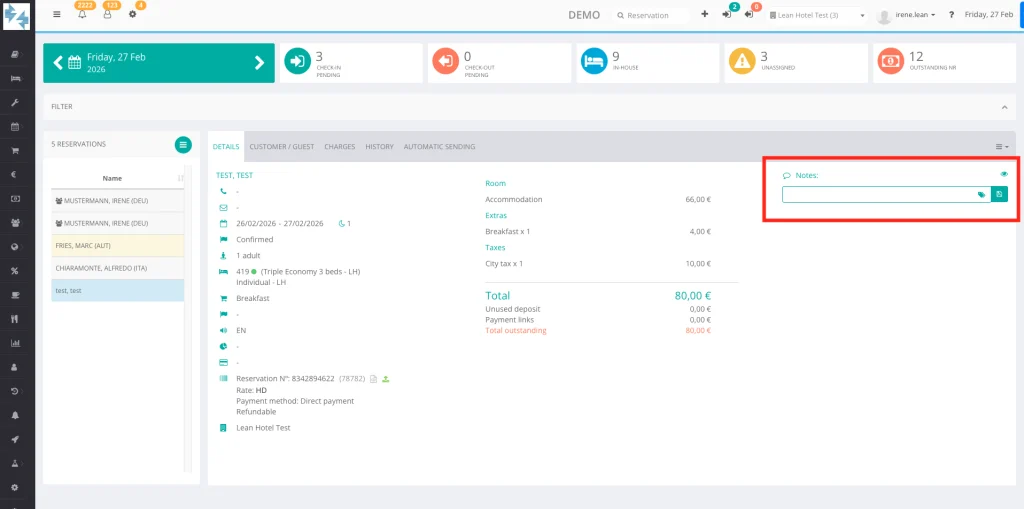
To ensure that this learning is not lost, it is important to leave traceability in the PMS. On LEAN, In this case, it is advisable to record the incidence and the action taken both in the reservation (context of that stay) as in the GUEST FILE (future patterns and preferences). And if the solution involves a change of room, register the reason for the change helps to maintain internal coherence and analyse causes.

Why a well-managed complaint can increase loyalty (if you do 3 things right)
A complaint is a “moment of truth”: the guest already has an expectation and something has broken it. If the hotel responds quickly and resolves it effectively, it can reinforce the perception of professionalism and care. What often makes the difference is:
- SpeedThe guest notices that the hotel takes the problem seriously.
- Professional empathyThe experience is validated without entering into discussions.
- Effective solutionThe problem is fixed or its impact is proportionally reduced.
When this happens, it reduces escalation (discussions, formal complaints), lowers indirect costs (time, improvised compensation) and, in some cases, improves the likelihood of a fairer review. In addition, the hotel learns and avoids repeating the same mistake.
The first minute: how to respond to defuse tension without relinquishing control
At reception or as a manager on duty, the first minute determines whether the complaint turns into a conflict. A simple approach:
- Listen without interrupting and ask for a key detail if it is missing (“in which room?”, “since when?”).
- Confirm your understanding (“So the problem is...”).
- Sorry for the experience without entering into blame (“I'm sorry for the inconvenience it is causing you”).
- Commits action and time (“I'm going to check it now and in 10 minutes I'll give you a solution/update”).
Short model sentences (without sounding scripted):
- “I understand what you are saying. Let me check it out right now and get back to you in a few minutes with a solution.”
- “Sorry for the inconvenience. We'll sort it out as soon as possible; I'll confirm the next step in X minutes.”
The idea is to lower tension with clarity and maintain control with a plan.
What NOT to do (even if it seems logical)
- Argue or “prove” that the host is wrong.
- Justify yourself before understanding the whole problem.
- Promise something you cannot deliver (impossible upgrade, reimbursement without authorisation).
- Blame third parties (supplier, OTA, “it's just that the hotel...”).
- Leave it “for tomorrow” if it affects the current rest or stay.
- Ask you to repeat the story several times to different people unnecessarily.
Rapid diagnosis: classify the complaint to decide on the best response
To respond judiciously, classify the complaint in 30-60 seconds along three axes:
- UrgencyShould action be taken now (night noise, breakdown) or can it wait (minor request)?
- Impacthigh/medium/low depending on whether it affects rest, safety, hygiene or charging.
- CauseRoom, noise, cleanliness, service, charge, expectations (what the guest thought was included).
Useful schema: type of complaint → target for resolution
- Cleanliness/Status → regain confidence + correct standard.
- Noise/rest → minimise immediate impact (change/measures) + prevent recurrence.
- Maintenance → solve or isolate the problem and provide an alternative if it persists.
- Charging/invoicing → clarity, traceability and correctness where appropriate.
- Expectations → align information and offer a reasonable alternative.
When a change of room is the best solution (and when it isn't)
It is often the best option when the problem is structural or persistent:
- structure-borne or recurrent noise,
- air conditioning that does not stabilise,
- odours, damp or incidents that are difficult to resolve quickly,
- serious breakdowns,
- incompatibility with host needs (e.g. noise sensitivity),
- assignment or typology errors that cannot otherwise be adjusted.
It is not always advisable if the hotel is very full and the change will generate another issue (worse room, even higher expectations). In such cases, a technical solution + proportional compensation may be better. If the change is made, the reason and the action should be documented.
Loyalty building solutions: compensate judiciously (not “give for the sake of giving”).
The most effective trade-off is usually: quick solution + appropriate detail. The objective is not to “buy” the guest, but to restore perceived value and trust without unnecessarily eroding margin.
Examples of compensation with high perceived value (depending on availability and internal policy):
- late check-out,
- upgrade if necessary (especially after a change of room),
- breakfast or extra service,
- parking,
- a detail in the room or a consumption voucher.
Proportionality matters: a minor incident may be resolved with an apology and quick action; an incident affecting rest or hygiene usually requires a more forceful solution and follow-up.
The differential point: document the incident so that the guest will notice “memory” the next time.
A complaint is converted into loyalty when the guest perceives that the hotel learn and remember. If it comes back and the hotel avoids repeating the problem (e.g. quieter allocation), the impact is very high. To achieve this, it is necessary to record what happened.
Here LEAN helps as an operational repository: it records in the booking (what happened that time) and in the guest record (what matters for future stays). This avoids relying on shift memory or informal messages.
In LEAN: where to record information (booking vs. guest record)
- Comment on the reservationUse it for the specific context of the stay. What happened, when, who handled it, what solution was applied and if there is any outstanding follow-up.
- Comment in the guest's fileUse it for future patterns or preferences. For example: sensitivity to noise, request for an indoor room, relevant allergies, recurrent cot need, or history of an incidence to be prevented.
Thus, the information is where it is needed: the reserve to operate today and the token to anticipate tomorrow.
If the complaint results in a change of room: record the reason for the change.
When a complaint ends in relocation, record the reason for the change (noise, breakdown, cleaning, recovery upgrade, etc.) and the action taken brings three benefits:
- Internal traceability: anyone can understand why the host was moved.
- Analysis of causesYou detect recurring rooms or problems.
- Better future allocationsYou avoid putting the same guest in similar conditions.
This is an operational detail that reduces repetition of incidents and internal discussions.
Hot closing: confirms satisfaction and avoids negative review
A good resolution without closure can end in a negative review “because nobody asked again”. Before the check-out (or after the resolution), it pays:
- Confirm that the problem was resolved (“Is everything OK now?”).
- Offer a direct channel if it happens again (“If you notice anything else, let me know and we'll sort it out quickly”).
- Acknowledge the notice (reinforces that the guest helped to improve).
The aim is to close the loop professionally, not to ask for a review.
Post-stay follow-up messages (if applicable)
1-2 lines, natural and specific:
- “Thank you for alerting us to the incident. We have made a note of what happened and the actions taken. If there is anything outstanding, please reply to this message and we will review it.”
- “We are sorry again for the inconvenience; we confirm that the team has applied the correction. We remain at your disposal should you have any further questions.”
Metrics and weekly routine to bring complaints down (and not just put out fires)
The difference between “managing complaints” and “reducing complaints” is in reviewing patterns. A simple weekly routine (30-45 minutes) might include:
- types of complaints by category (noise, cleanliness, maintenance, charging),
- repeater rooms or areas with incidents,
- resolution times (fast vs. slow),
- compensations made (type and recurrence),
- estimated cost (time + services offered),
- impact on reviews (recurring comments).
In small hotels, this can come from exports from the PMS or from a simple internal register, as long as it is consistent.
Signs of “recurrent complaint” requiring corrective action
- Same room or same area repeatedly.
- Same time slot or same shift (possible processing problem).
- Same provider or service (maintenance, laundry, etc.).
- Same type of charge or confusion in billing.
- Repeated comments in reviews even if they are “resolved” on the spot.
Practical prioritisation: frequency × impact (those affecting rest and hygiene tend to have high priority).
Metrics and weekly routine to bring complaints down (and not just put out fires)
To ensure that management does not depend on a single person, a weekly 15-minute micro-training session works well:
- role-play of 1 real case of the week,
- remember compensation limits per role (what can authorise reception, what scale),
- review the “first minute” and the hot closure,
- and remember where to register in LEAN (booking vs. guest record, and reason for room change if applicable).
The consistency of the team reduces escalations and improves the perception of the hotel's professionalism.
Frequently asked questions on how to turn a complaint into loyalty (hotel)
What is the best immediate response to a complaint at reception?
Listen without interrupting, confirm that you have understood the problem, apologise for the experience (without getting into arguments) and commit to a next step with a clear time frame. For example: “I'll review it now and in 10 minutes I'll confirm the solution”. This combination reduces tension and maintains control of the process.
When should I change my room due to a complaint?
It is usually appropriate when the problem is persistent or difficult to solve quickly: structural noise, air conditioning failure, odours, humidity or a serious cleaning incident. If a change is decided, it is advisable to record the reason and the action taken to maintain internal traceability and avoid repeating the case.
What rewards are most likely to build loyalty without lowering the price?
Compensation with high perceived value and low direct impact on the rate tends to work best: late check-out, upgrade if applicable, breakfast, parking or a courtesy gift, always in proportion to the incident. The most important thing is that the solution is quick and the compensation makes sense for the guest.
How do I avoid repeating the same complaint with the same guest?
Document the occurrence and the resulting preference in the PMS and use it for future assignments. For example, if the guest is sensitive to noise, make a record to assign quieter rooms. Operational “memory” reduces repetition and improves the perception of care, even if the original incident was serious.
Where do I register a complaint in the PMS so that it does not get lost?
In LEAN, it records the context of impact on the reservation (what happened and what was done in that room) and, if it is a relevant pattern or preference, also in the GUEST FILE. If there has been a change of room, also record the reason for the change, because it helps traceability and operational learning.
How do I reduce negative reviews after resolving an issue?
Close hot: confirm with the guest that the solution worked, offer a direct channel if they reappear, and thank them for the notice. This follow-up before check-out reduces the likelihood of the guest “venting” in a review despite having been attended to. Avoid asking for reviews; prioritise the experience.
What metrics should you review to improve complaint handling?
Frequency by category and room, resolution times, trade-offs (type and recurrence), estimated cost of operational time and effect on reviews (repeated issues). With a simple weekly review you can detect root causes and prioritise corrective actions, rather than resolving issues as isolated cases.
You may also be interested in


Adaptability in the sales process
Adaptability allows sales teams to adjust their strategies according to customer trends and preferences. In a changing marketplace, it is vital that the sales team responds quickly to customer expectations, maximising conversion opportunities.
REQUEST YOUR DEMO TODAY
Discover how Lean Hotel System can transform your hotel business