


How to measure staff performance in a hotel without hassle (KPIs and simple routines)
Measuring performance in a small hotel should not become a “control project” or bureaucracy. Done well, it serves a much more useful purpose: improving service, planning shifts with less stress, sharing the load more fairly and reducing errors that cost time and reputation. The key is to accept one reality: you don't need perfect data; you need few, comparable and actionable indicators.
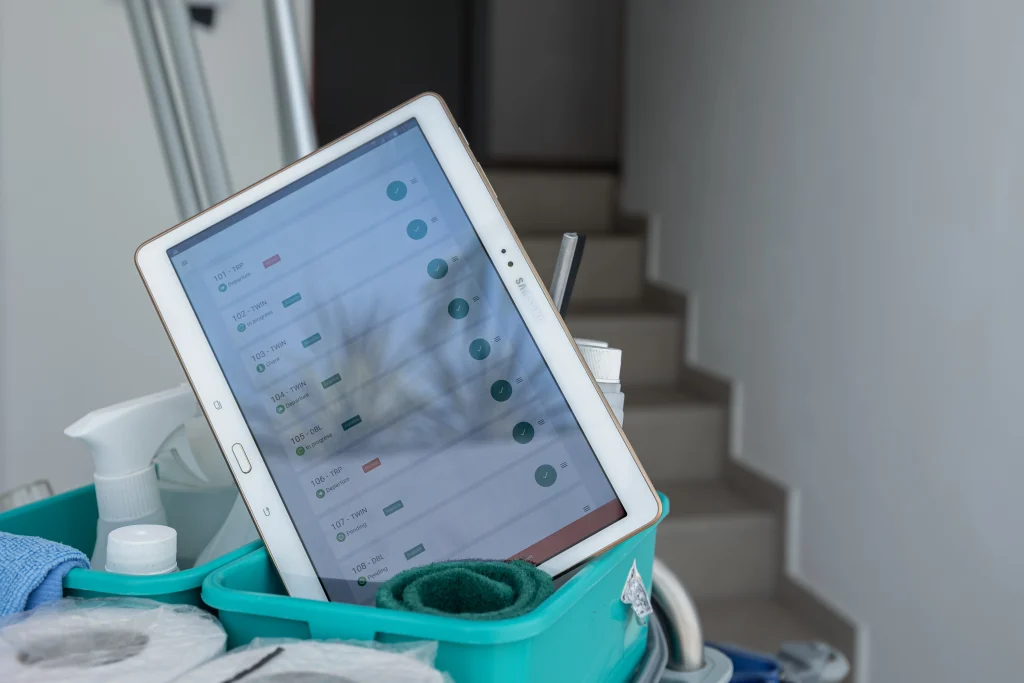
In this approach, technology helps when it generates data as part of the work. In LEAN, the most relevant point to measure performance without extra effort is the Housekeeping App, because it allows to manage and measure how the floor department works (room allocation, status, reporting and follow-up), without forcing the team to “report for the sake of reporting”.

The right approach: measure to improve service, not to “control for control's sake”.”
Measurement works when the team perceives it as a tool to improve day-to-day operations, not as surveillance. Its typical benefits in small hotels are very concrete: detecting bottlenecks (why rooms are not ready on time), better planning of shifts, reducing charging or coordination errors and avoiding burnout due to poorly distributed workloads. In addition, when you measure judiciously, you can make fairer decisions: differentiate a process problem from a resource problem.
To achieve this, KPIs should be few in number and always have an action associated with them. If the number changes and you don't know what to do, it's not a useful KPI; it's noise.
Golden rules for measuring without complications (and without perfect data)
In small hotels, sustainability is often simple. A few practical rules:
- Few KPIs per areaBetter 3 good ones than 12 mediocre ones.
- Define a standardWhat does “room ready”, “issue resolved” or “successful check-in” mean?.
- Measures with a fixed periodicity: daily for operation, weekly for improvement, monthly for trend.
- Combines quantity and qualityif you only measure volume, you punish good work.
- Same criteria for allAvoid changing your period every week.
- Record key incidentswithout context, numbers are misinterpreted.
What makes a KPI useful in a small hotel
A useful KPI has three characteristics. It is actionable (if it goes up or down you know what to check), it is cheap to measure (it does not depend on infinite leaves) and it is just (do not penalise the one who receives more difficult tasks). If a KPI generates discussions about “not comparable”, you need to adjust the standard or the context, not insist on ranking.
Simple KPIs by department
The idea is not to measure “everything”, but what affects service and availability. For each department, choose 3-5 KPIs maximum and define how they are measured.
Reception: productivity + quality of service
In reception, measuring “speed” without quality is often a mistake. Sustainable KPIs:
- Check-in time by slots (estimated): no need for a host timer; just observe peaks (18-20h) and compare weeks.
- Collection errors/foliosnumber of incidents detected in closures or complaints.
- First response resolutionhow many incidents are resolved without rescaling or “come back tomorrow”.
- Reception-related complaints (category in a single register).
- Upselling/sales of extras if applicable, as a signal of opportunity, without obsession with volume (the important thing is consistency and relevance).
Typical actions: simplify check-in with pre-data, reinforce folio checklist, improve handover between shifts.
Housekeeping: measurable performance with tasks and room statuses
Here measurement has a direct impact on availability and experience. Useful KPIs:
- Rooms cleaned in turn, ideally weighted by typology if there are large differences.
- Rotation time (check-out to “ready”): key indicator for availability.
- % of rooms ready before a target hour (defined by your operation).
- Incidents per room (missing parts, maintenance, special cleaning).
- Re-cleaning or failed inspections: balance of quality.
Typical actions: prioritisation by arrivals, redistribution by zones, reinforcement of standards and closure of incidents.
Maintenance: speed of response and prevention
Measuring maintenance helps reduce out-of-service rooms and complaints. Sustainable KPIs:
- Response time to incidents (from the time of registration to the time it is dealt with).
- Resolution time (until actual closure).
- Repetition of faults (same room or same type of failure).
- Rooms out of order and duration.
- Open critical incidents (those affecting safety or rest).
Typical actions: prioritise by occupancy, simple preventive plan, improve detail when reporting incidents.
Management/operations: stability of service with available equipment
The “operational health” of the hotel is of interest here, not the detail of each action:
- Complaints by category (cleanliness, noise, charges, service).
- Compliance with ready rooms (whether or not the target time is being reached).
- Cost of compensation for failures (without going into complex finances: how many and why).
- Shift loading and saturation points (where the system breaks down).
- Turnover/absenteeism if recorded by the hotel (as a sign of sustainability).
Typical actions: adjust shifts, simplify processes, attack recurring root causes.
How to measure performance without unfair comparisons
The most common mistake is to compare “people” without comparing “contexts”. To be fair, introduce simple adjustments:
- Weighing by typology (a suite is not a standard suite).
- See zones (distances, building layout).
- Difference days of high occupancy vs. low.
- Mark rooms with incidents (maintenance, special cleaning).
- Avoid aggressive rankings; use ranges and trends (“below standard”, “on target”, “above”).
Measurement should be used for load balancing and process improvement, not to generate unproductive internal competition.
Quality indicators balancing quantity KPIs
So that quantity does not distort reality, combine with 3-4 quality signals:
- Re-cleaning or failed inspection.
- Complaints about cleanliness/room condition.
- Repeated incidents per room.
- Review scores related to cleanliness and service (as a trend).
Minimum monitoring routine: Daily (10 minutes) + weekly (30 minutes)
Measurement works when it fits in the agenda.
Daily (10 minutes)Operational review.
- state of rooms and slopes,
- open incidents (what blocks availability),
- peaks of the day (early arrivals, groups),
- clear priorities in turn.
Weekly (30 minutes)continuous improvement.
- review 3-5 KPIs per area,
- identify 1-2 main causes,
- agree on 1-3 concrete actions (with responsible person and date).
Recommended weekly review template (very simple)
A short table (on a sheet of paper or in a document) is sufficient: KPI | target | result | cause | action | responsible party | date. The key is not the table; it is that it always ends in actions and follow-up.
How the Housekeeping App helps measure floor department performance
In small hotels, measuring floors often fails due to a lack of traceability: you don't know when it was cleaned, what was left over or why a room was delayed. The Housekeeping App avoids that because the data is generated as you work: you assign rooms, update statuses, record incidents and see progress in real time.
This allows measurement without asking for extra reports: the system reflects the shift load and progress, and helps to monitor fairly and quickly.
What you can measure automatically with mapping and reporting
Without turning it into micro-management, useful metrics often emerge:
- productivity per shift (and, according to internal policy, per employee),
- times between states (pending → in progress → ready),
- expected load of the day (departures, urgent arrivals),
- pending rooms by time slot,
- recorded incidents and closure time.
The value is operational: detecting bottlenecks and distributing work better, without chasing the team with questions.
How to communicate these KPIs to the team for improvement
Communication defines adoption. What usually works:
- Explain the “why”: less stress, less urgency, more fairness in the burden.
- Few clear targets per week, not ten.
- Short and frequent feedback is better than long meetings.
- Recognise real improvements (rooms ready on time, less re-cleaning).
- Use data for load balancing, not punishment.
Signs that you are measuring too much
If the team stops updating, if there are constant discussions about numbers, if reports are generated but no actions are taken, or if you change KPIs every week, the system is heavy. In that case, go back to basics: 3 KPIs per area and a weekly improvement routine.
Common mistakes when measuring hotel performance
Typical failures are measuring only quantity, not defining standards, comparing different shifts without context, not closing actions (measuring but not improving), measuring “the easy” and forgetting the important, or changing KPIs every week. The solution is usually the same: simplify, standardise and maintain a fixed cadence.
Frequently asked questions on how to measure staff performance in a hotel
How many KPIs should I measure at most in a small hotel?
The most sustainable is usually 3-5 KPIs per department. With fewer, you lose visibility; with more, it becomes bureaucracy. The important thing is to review them weekly and for each KPI to have an associated action when it deviates, rather than accumulating numbers that no one uses.
How do I measure housekeeping fairly if the rooms are not equal?
Adjust for context: weight by typology (suite vs. standard), consider zones or distances and mark rooms with special incidences. Compare “like with like” and review trends by shift instead of aggressive rankings. Complement quantity with quality (re-cleaning, complaints, failed inspection).
Which KPI is most important to improve availability?
Two stand out: the rotation time (from check-out to room ready) and the percentage of rooms ready before the target time. To be useful, accompany it with a quality signal (failed inspections or complaints) so as not to accelerate at the expense of the standard.
How often should I check the performance of the equipment?
A practical model is a 10-minute daily check for operation (pending and priorities) and a 30-minute weekly review for continuous improvement. On a monthly basis you can look at trends and adjust standards or targets seasonally. The key is consistency, not data perfection.
How do I use a housekeeping app to measure performance without “micromanaging”?
If the app is used to assign tasks and update statuses, the measurement comes out on its own: progress per shift, times between statuses, pending and incidents. Use it to balance load and detect bottlenecks, not to audit every minute. The goal is for the data to help you plan and reduce urgencies.
What do I do if KPIs worsen during a peak season?
It is normal for numbers to be strained at peak times. Instead of “punishing”, adjust targets temporarily, prioritise non-negotiables (cleanliness, safety, correct collections) and review the flow: are there too many urgencies due to lack of pre-planning? Use the week to identify the main bottleneck and act there.
You may also be interested in


REQUEST YOUR DEMO TODAY
Discover how Lean Hotel System can transform your hotel business