


Safe Handling of Chemicals and Cleaning Products in a Hotel (Housekeeping Guide)
Housekeeping works with products that, when used correctly, are safe and effective, but when misused can cause irritation, damage to surfaces, rooms out of order and, in serious cases, accidents. This guide is aimed at small hotels and focuses on applicable good practice, training and operational control.
The specific requirements depend on the local regulations, of the Occupational risk prevention of the hotel and the safety data sheets (SDS) of each product. The basic rule is always the same: follow the manufacturer's instructions and the hotel's internal procedures.
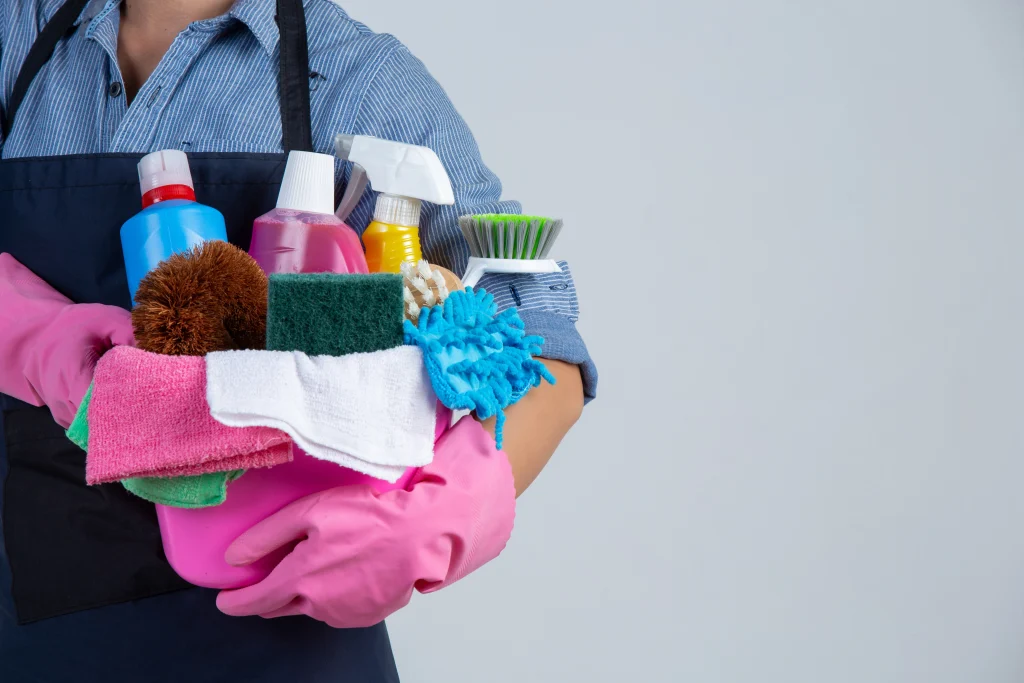
Real risks in housekeeping: why chemical safety affects quality and service
The usual risks do not usually come from “using chemicals”, but from using the wrong products, in the wrong quantities or without control. On a day-to-day basis, the most frequent problems are:
- Irritations of skin and eyes from splashes or repeated contact.
- Inhalation of vapours or aerosols in bathrooms and poorly ventilated areas.
- Burns chemicals due to accidental exposure or incorrect mixing.
- Slips due to spills or excess product.
- Dangerous mixtures for “testing” or misidentified transfers.
- Cross-contamination (for example, using the same tool in different areas without good reason).
- Damage to surfaces (chrome-plated, textiles, sealed, wood) due to overdose or inappropriate product.
Operational impact: casualties and turnover due to accidents, guest complaints due to intense odours or irritations, more time spent reworking, more maintenance issues and blocked rooms.
Basic principles of safe handling
If your team could only remember 6-7 rules, they should be these:
- Use the right product for each task and surface. (according to hotel procedure).
- Do not mix products.
- Respect dilution/dosage indicated by the manufacturer (never “by eye”).
- Always label any decanted or diluted packaging.
- Ventila toilets and enclosed areas while cleaning.
- Wear PPE according to product and task (SDS/label).
- Stores and transports chemicals in a controlled manner (originals where possible, closed cabinets, partitions).
Critical rule: never mix products “just to try”.”
Mixing products is the most dangerous and, at the same time, one of the most common mistakes in a hurry. As a general principle, no mixing of products even if they “appear” to clean more. Well-known examples of dangerous mixtures include: Bleach with ammonia o bleach with acidic products (e.g. descalers). If in doubt, the answer is not to experiment: it is to consult the SDS and ask the person in charge or supervisor.
Safety Data Sheets (SDS): The bare minimum your team needs to know
The SDS (Safety Data Sheet) is the official product document and is the reference when in doubt. Without getting too technical, the team should be aware that the SDS is for:
- Identify risks and precautions for use.
- Knowing what EPI corresponds according to task/exposure.
- See incompatibilities (what should not be mixed or stored together).
- Consult general guidelines for FIRST AID and action in case of exposure (always following PRL and professional assistance where appropriate).
- Confirm conditions of storage and manipulation.
In small hotels, the critical point is not “having SDS”, but that it is accessible and searchable in turn.
Where to store SDS and how to make sure they are actually consulted
A practical system usually includes two accesses:
- Physical folder in the chemical area with the current SDS.
- Digital version accessible for monitoring/management (intranet, shared folder, internal QR).
To make it usable, it works well to add a visual summary by product (pictograms, PPE, “do not mix”, ventilation), always validated by quality/PRL. The summary does not replace the SDS: it accompanies it for quick decisions.
Labelling and decanting: the point where most mistakes happen
Many incidents start with an “unlabelled” bottle or a reused sprayer without identification. Operational rule: no unlabelled packaging is used, even if “everyone knows what it is”.
A minimum standard of labelling for decanted or diluted packaging should include:
- Name of the product (as known to the hotel).
- Dilution or prepared concentration (if applicable).
- Preparation date (if defined by the hotel).
- Basic warnings (e.g. “do not mix”).
- Manager or shift (if defined by the hotel).
This reduces errors, speeds up onboarding and avoids improvisations on high load days.
Colour standard and codes to avoid confusion
In small hotels, a simple system can work, always aligned with internal training. Two common options:
- Colours per zone (bathroom / room / floors).
- Colours by product type (disinfectant / degreaser / glass).
What is important is that the code is consistent, that it is explained in onboarding and that it is not “reinvented” by turns.
Dilution and dosage: safety + cost + consistent results
Diluting “by eye” is a triple problem: it increases exposure (odour/vapours), it can damage surfaces and it is expensive because more product is used than necessary. In addition, overdosing does not always clean better: it sometimes leaves residues, stickiness or marks.
Applicable good practices:
- Use dosificadores/medidores where possible.
- Define a standard per task (what product and how it is prepared) and train it.
- Avoid “boosting” mixtures or concentrations without the authorisation of the responsible person and without SDS.
Signs of overdosage and misuse
If these signs appear, it is advisable to stop and check the procedure:
- Persistent strong odour in the room or bathroom after cleaning.
- Irritation or discomfort to the equipment when using a “regular” product.
- Sticky residues or film on floors and surfaces.
- Stains, discolouration or damage to chrome, textiles or seals.
- Increase in slips or surfaces that are too “soapy”.
In these cases, the correction is usually: check dilution, ventilation, correct product for the surface and formation of the procedure.
PPE and ventilation: what should be automatic on a day-to-day basis
PPE is not “for when there is an inspection”: it is a real safety barrier. The concrete choice depends on SDS and label, but in a practical approach:
- Gloves for chemical handling and repeated contact tasks.
- Goggles or eye protection where there is a risk of splashing.
- Mask when the product generates aerosols, intense vapours or as indicated by the SDS.
- Ventilation Systematic in bathrooms and enclosed areas: door open when possible, extractor fan, window, airing times.
Ventilation also protects the guest: it reduces residual odours and complaints of “chemical smell” in ready rooms.
How to ensure availability of PPE without slowing down work
The most common cause of “not used” is “not available”. Simple solutions:
- Visible replenishment points (floor office and, if applicable, warehouse).
- Quick checklist at the start of the shift: gloves, bags, wipes, critical PPE.
- Responsible for stock (supervision or designated person) and weekly review.
Secure storage in the hotel: office floors, trolleys and restricted areas
Unsafe storage creates risks for staff and guests. General guidelines:
- Saving chemicals in closed cabinets and, where applicable, ventilated.
- Maintain Original packaging whenever possible.
- Separate products incompatible according to SDS/internal procedure.
- Avoid sources of heat and unnecessary exposure.
- Never store in areas accessible to guests or children (corridors, public areas, uncontrolled rooms).
Cleaning trolley: what to bring and what NOT to bring
In the car, less is more for safety and control:
- Carry only what is necessary for the assigned shift or plant.
- Packaging always closed and labelled.
- Avoid transporting large volumes “just in case”.
- Do not leave the car unattended in corridors or public areas.
- Separate tools by zone when the hotel is colour-coded (to avoid cross-contamination).
Incident protocol: spills, exposure and odour complaints
When an incident occurs, the important thing is to act in an orderly manner and not to improvise. A safe general protocol:
- Stop the task and secure the area (prevent slipping or access by third parties).
- Ventilation and insulation the area if fumes or strong odour are present.
- Inform the supervisor or shift leader.
- Consult the SDS and follow the procedure PRL of the hotel.
- If there is relevant exposure or symptoms, seek professional assistance according to internal protocol (health/PRL).
- Record the incident and review the cause so that it does not recur.
This approach applies to both spills and odour complaints: you don't “cover up” the problem; you identify which product, which dilution, which ventilation and which process failed.
What to register so that it does not happen again
A minimum and useful register includes:
- Product involved and format (original/packaged).
- Task and area (room, bathroom, corridor).
- Time and shift.
- Probable cause (spillage, overdosage, lack of ventilation, unlabelled container).
- Measures taken (ventilation, cleaning, removal, warning).
- Corrective action (retrain, adjust dosage, change process, check storage).
Training and task-based standards: the most effective way to reduce risks
Chemical safety should not depend on “the senior person”. What works best in small hotels is:
- Structured onboarding for new recruits.
- Periodic microforming (15-20 minutes) with one real case or product per week.
- Procedure sheets per task (baths, glass, textiles, disinfection), with authorised product, PPE and critical points.
Checklist of minimum competencies for new housekeepers
Before working autonomously, they should master:
- Read label and locate the SDS of the product.
- Know which products do not mix (rule of thumb: never mix).
- Prepare dilutions according to hotel standard (no “eyeballing”).
- Label any transfer or sprayer.
- Choose PPE according to label/SDS and apply ventilation.
- Controlled storage and transport of chemicals.
- Report incidents and record what happened according to protocol.
Floor-maintenance coordination: safety and control with clear communication
Many causes of risk are not solved by “better cleaning” alone: damp, mould, poor ventilation, failed dispensers, damaged surfaces or deteriorated seals lead to repeated chemicals and unnecessary exposure. Therefore, smooth coordination with maintenance reduces risks and avoids out-of-service rooms.
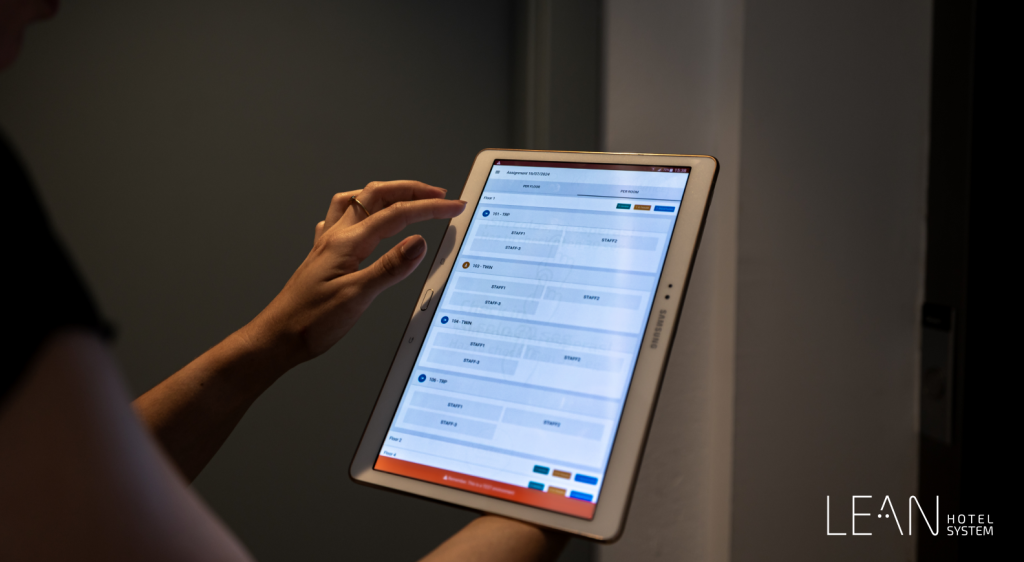
This is where LEAN PMS can fit in as a control support: a Housekeeping App makes it easy to record incidents, follow up and ensure traceability so that it doesn't just remain “I told someone”.
How to use a Housekeeping App to reinforce security (without bureaucracy)
The idea is not to add reports, but to standardise warnings:
- Record occurrence with context (area, task, risk: strong odour, spillage, ventilation).
- Assign it to the person responsible for maintenance or supervision.
- Track status (pending/underway/resolved).
- Record the resolution to avoid repetition (e.g. extractor adjustment, dispenser repair, seal check).
This reduces the “no warning” and closes the preventive cycle.
Shopping and product selection: less variety, more control
The more different products there are, the more likely it is that someone will use the wrong one or improvise a mix. A prudent strategy in small hotels is to Rationalise the catalogue: less referrals, more standardisation and better training.
Good practice:
- Choose products suitable for the actual surfaces of the hotel (and maintain consistency).
- Ensure that each product has SDS available and a standard of use.
- Treating product changes as a process change: they require retrain and update labels/standards.
Preguntas frecuentes sobre el manejo seguro de químicos en actividades de limpieza
The most dangerous mistake when using cleaning products in a hotel is mixing different chemicals.
The most dangerous error is usually Mix products to improvise combinations “so that it cleans more”, and also to use unlabelled containers transferred. Both situations increase the risk of hazardous fumes, burns or misuse. Safe practice is not to mix, follow SDS and consult supervisor if in doubt.
What should be on the label of a sprayer that has been transferred?
At a minimum: product name, dilution or prepared concentration (if applicable) and basic warnings (e.g., “do not mix”). Many hotels add the preparation date and responsible person/shift for traceability. The important thing is that no one uses an unlabelled container and that the labelling is consistent with the internal standard.
How do I know which PPE to use with each chemical?
It is defined by Product label and his SDS, where hazards and recommended protection are indicated. As a general guideline, gloves are usual, eye protection if there is a risk of splashing and a mask when there are aerosols/vapours or as indicated by the SDS. If in doubt, consult the hotel's SDS and PRL.
Where should SDS sheets be stored for staff to consult?
The most practical approach is dual access: a physical folder in the apartment office (or chemical area) and a digital version accessible for supervision. Additionally, a visual summary per product (PPE, “do not mix,” ventilation) validated by H&S/quality is helpful. Supervisor training is key to them being properly consulted.
What do I do in case of a spill or accidental exposure?
Stop the task, secure the area (avoid slips or third party access), ventilate/isolate if fumes are present, inform supervisor and follow SDS and hotel OHS protocol. If exposure is relevant or symptoms are present, seek professional assistance according to internal procedure. Then record the incident and review the cause.
How does coordination with maintenance improve chemical safety?
Many risks recur due to technical causes: poor ventilation, dampness, damaged surfaces, or malfunctioning dispensers. If maintenance acts quickly and follow-up is carried out, the need to “reinforce chemicals” and the team's exposure are reduced. A Housekeeping App can help to record incidents, assign them, and provide traceability until closure.
You may also be interested in


REQUEST YOUR DEMO TODAY
Discover how Lean Hotel System can transform your hotel business