


Unattended hotel receptions: digitisation and unmanned experience
The unattended receptions o hotels without counter are no longer a futuristic oddity, but an increasingly common reality in Europe.
Change has been accelerated by two major factors: travellers' expectations and the need to optimise hotel operations.
With these facts in mind, let's explore what digitising the front desk entails and how this trend can become a competitive advantage for your hotel.
What is unattended reception and why is it gaining ground?
An unattended reception is a concept that eliminates the need for a traditional front desk. In this model, check-in and check-out processes are handled digitally through mobile apps or self-service kiosks, allowing guests to access the room without interaction with staff.
Access is via a virtual key or digital code sent to the customer's device or proximity keys provided by the kiosks. This approach does not imply an absence of service; in fact, remote assistance via phone call, chat or video call offers immediate support if an issue arises.
Why is this model taking off? The answer lies in the evolution of expectations. Travellers are looking for control and flexibility: arriving at any time without depending on a reception timetable and managing their stay from their mobile.
At the same time, younger generations value intuitive digital experiences. In addition, for hoteliers, automation represents an opportunity: it reduces operational burden, allows them to operate with fewer staff and frees up time for higher-value tasks. These motivations explain why many hoteliers plan to implement technology that will improve the front desk experience or eliminate it altogether by 2025.
How an unstaffed reception works
Contactless check-in relies on different technological pillars: the online pre check-in, the self-service kiosks and the digital key. Prior to arrival, the guest receives a link or code by mail or SMS to complete a pre-registration, enter their details and even make payment. This version allows them to verify documents and payments in advance, speeding up the handover of keys when they arrive at the establishment. Upon arrival, the guest has several options:
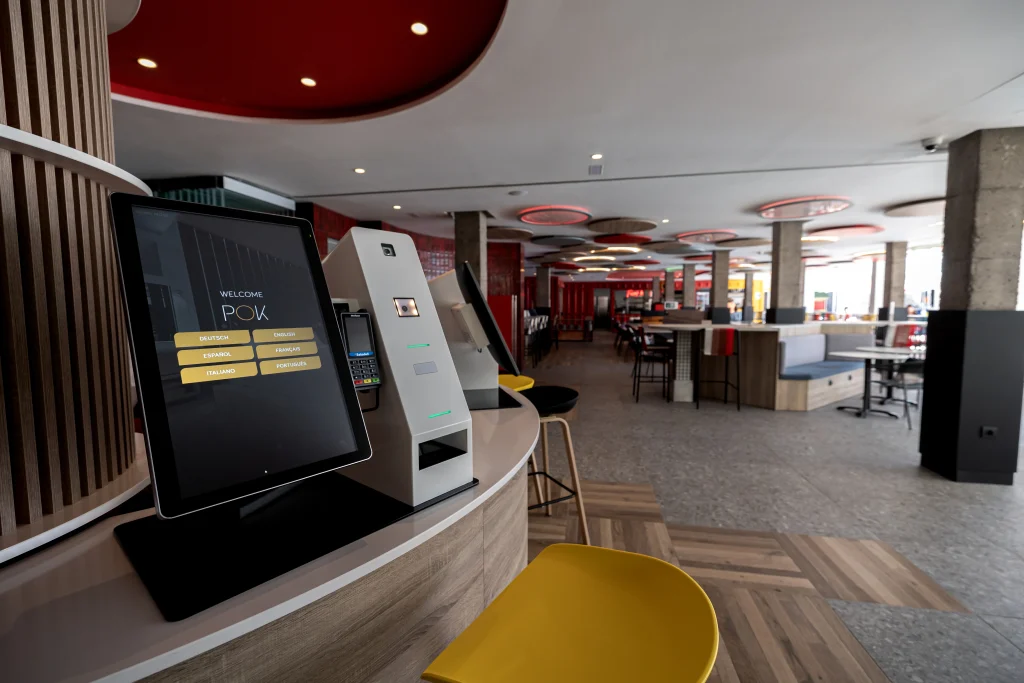
📌Self-service kiosk: At the entrance there is a touch terminal where the customer enters their reservation code or scans a QR, formalises their check-in and obtains the physical or digital key (pin). This option reduces queues and frees staff from repetitive tasks.
📌Virtual check-in: Some properties have a QR code at reception that allows guests to complete the self check-in process from their own mobile device. Once completed, the system generates and sends a PIN code to access the room.

After the stay, check-out is automatic: the digital key is deactivated, any outstanding consumption is charged to the registered card and the guest simply leaves the room.
From an operational point of view, a cloud-based PMS such as LEAN Hotel System allows you to centralise all your hotel management (reservations, billing, reporting and more) on a single platform accessible from any device. Its intuitive interface reduces the need for training, making it easy for hotel managers, operations managers and IT teams to adopt.
POK, the check-in and check-out management solution, offers different modes of use and integrates natively with LEAN, ensuring a seamless and fully connected experience for both staff and guests.
Advantages of automated reception versus the traditional model
Automation not only modernises the guest experience, it also impacts profitability and efficiency. The main benefits for both profiles are summarised below:
For guests
- Time flexibilityThe fact that there is no need to rely on a physical counter means that travellers can arrive or leave at any time.
- Queue reductionWith digital check-in, there is no unnecessary waiting, which improves satisfaction and reduces stress.
- Ease of use and privacyThe apps and kiosks provide clear instructions, even for those who do not speak the local language, and allow for non-interactive check-in and check-out management, providing privacy.
- Personalisation and autonomyThe client manages his stay, and can consult and contract additional services or extras not included in his initial booking.
For hoteliers
- Reduction of operating costsBy optimising reception shifts, salary costs are reduced and can be reinvested in improving the facilities or in other key areas. Moreover, in a context in which it is increasingly difficult to find qualified staff in the sector, automatic check-in becomes a solution that allows operations to be maintained without depending so much on the availability of staff, guaranteeing continuous attention to the guest.
- Optimisation of human resourcesAutomation frees staff from repetitive tasks so that they can focus on more personalised service. In this way, digitisation does not replace, but complements the team.
- Improved securityDigital keys and access codes are difficult to duplicate, and the systems record every entry and exit, improving traceability.
- Scalability and controlA cloud PMS makes it easy to monitor multiple properties, provides real-time reporting and allows the same automation rules to be applied across multiple locations.
Comparison: traditional vs. unattended reception
| Aspect | Traditional reception | Unattended reception |
|---|---|---|
| Staff at reception | Requires 24-hour on-site shifts | Remote monitoring and small teams |
| Check-in/out | Manual, needs interaction with staff | Automatic via kiosk or host's own device |
| Operational costs | Raised by salaries and maintenance | Reduced, staff focus on value-added tasks |
| Guest experience | Time dependency and possible delays | 24/7 access, no queuing, no contact |
| Security and control | Physical keys, less traceability | Digital keys, automatic registers |
| Scalability | Limited, each hotel operates independently | Centralisation through PMS cloud and automations |
What a hotel needs to implement an unattended reception desk
Adopting a counterless model involves reviewing processes, technology and mindset. These are the essential components:
Modern cloud PMS
A PMS cloud as LEAN Hotel System is the core of the operation. It should centralise reservations, billing, housekeeping and other modules in an environment accessible from anywhere. The platform must offer connectivity with channel manager and external applications.
In addition, it must be adapted to local regulations (VAT, e-invoicing, GDPR, VeriFactu) to ensure legal compliance. The advantage of a light and intuitive PMS is that staff can use it without long training sessions, freeing up time for customer service.
Smart check-in solutions
In addition to the PMS, specialised check-in tools are needed. Our range POK offers several options:
It allows the guest to complete their registration and provide documentation prior to arrival. This solution streamlines identity verification, the signing of travellers' statements and the collection of guarantees. It also reduces human error and complies with local authority requirements.
Ideal for lobbies, it allows you to formalise check-in, generate keys and charge autonomously. Its multilingual interface enhances the experience for international travellers. It is integrated with LEAN to update availability and billing in real time.
Designed for hotels with PIN code locks. Guests scan a QR code on the property itself and complete their self check-in process by obtaining a code that opens both the building entrance and the room. This version avoids the installation of additional hardware and is perfect for independent accommodations.
Payment gateway and digital key
Any unattended receiving process must include an integrated payment gateway that allows payment in euro or other currencies in a secure and PCI-DSS compliant manner.
It is also necessary to have lock integration with the self check-in software.
Remote communication and assistance
Although the model is “unmanned”, the care is still there. The team can use instant messaging tools, phone calls... The combination of automation and human support is what creates the best experience.
Case studies and results in European hotels
Automated check-in solutions have been widely adopted in Europe, both in independent hotels and in medium-sized chains.
In 2022, approximately 40 % of hoteliers already offered some form of self-service check-in and 31.5 % used assisted processes. This percentage has grown by 2025, especially in Spain, Italy and Germany, where staff shortages and competition for guest satisfaction are driving digitalisation.
In chains of 5-10 properties, centralisation in the cloud allows operations managers to control all receptions from a single console. This visibility translates into more agile decisions, dynamic pricing and improved profitability.
Case studies and results in European hotels
How do you monitor security in a hotel without a reception?
It will depend on each property, some have codes to access the hall, these are unique and temporary and are deactivated at the end of the stay. In addition, the PMS registers all entrances and exits. In the event of an incident, staff can intervene remotely and, if necessary, block access. Security is supplemented by camera and sensor monitoring.
What kind of customers prefer this system?
Business travellers, technology lovers and guests who value privacy tend to be the most interested. However, hotels can offer the option of traditional check-in for those who prefer it, combining both worlds.
What happens if a guest has a problem upon arrival?
The absence of physical staff does not mean the absence of service. Most properties include other contact systems to resolve any incident.
How much does it cost to implement automatic reception?
Costs vary depending on the size of the hotel and existing technology. Investing in a cloud PMS and kiosks may have an initial outlay, but the savings on salaries and local hardware will pay back the investment in a few months. In addition, SaaS solutions such as LEAN and POK are based on scalable monthly subscriptions.
Can partial staffing be maintained on certain shifts?
Costs vary depending on the size of the hotel and the technology in place. Investing in a cloud PMS and kiosks can have an initial outlay, yes. Many hotels opt for a hybrid model where the unattended front desk operates during the night and part of the day, while on-site staff are kept on during peak times or on concierge duties. This combination maximises efficiency and provides a human touch when it is needed most, but the savings on salaries and local hardware pay for the investment in a few months. In addition, SaaS solutions such as LEAN and POK are based on scalable monthly subscriptions.
The future of housing is autonomous and connected
The digitisation of the front desk is much more than a technological shift: it is an operational and cultural change. Data shows that travellers increasingly value contactless options and hoteliers see automation as an answer to staff shortages and the need to improve the guest experience. Implementing an unattended front desk model does not mean eliminating service, but transforming it to free up resources, offer more autonomy and improve security.
Are you ready to take the plunge? Request a demo of LEAN and POK and find out how digitising your reception can boost your business.
You may also be interested in


REQUEST YOUR DEMO TODAY
Discover how Lean Hotel System can transform your hotel business