


«A PMS like LEAN Hotel System it allows you to manage the reservation, charges, extras, guest information, payments and stay status from a single environment. This helps front desk staff avoid having to piece together the check-out using notes, emails or different tools. "
LEAN Team
Hotel System
specialised in PMS
emerging
At reception it is common to encounter seemingly simple situations that end up generating doubts: a guest asking for an invoice in their company's name, a group that needs to know the amount before confirming, a booking with an advance payment or a customer who simply requests a receipt for what they have just paid.
The problem arises when terms are used interchangeably such as invoice, pro forma invoice and receipt, because they do not document the same thing nor do they necessarily serve the same function.
The idea of this guide is to organise its use from the perspective of hotel operations, not to replace the tax judgement of the establishment's accountancy or consultancy firm. Specific obligations may vary depending on the country, tax regime and characteristics of the operation.
In Spain, the Invoicing Regulations set out the requirements for full and simplified invoices, while the AEAT expressly distinguishes proformas or drafts from definitively issued invoices.
The key idea: not all documents are for the same purpose
The main difference can be summarised as follows:
- Invoice: it formally documents a transaction and must comply with the applicable tax requirements.
- Proforma invoice: it is a preliminary, informative or estimated document. It does not replace the final invoice.
- Receipt: normally it serves to prove that a payment, delivery of money or economic movement has taken place, but it should not be taken for granted that it replaces an invoice.
At reception, this distinction is important because a company needing to document a stay for tax purposes is not asking for the same thing as a guest who just wants to confirm they have paid a deposit.
What is a hotel invoice and when must it be issued
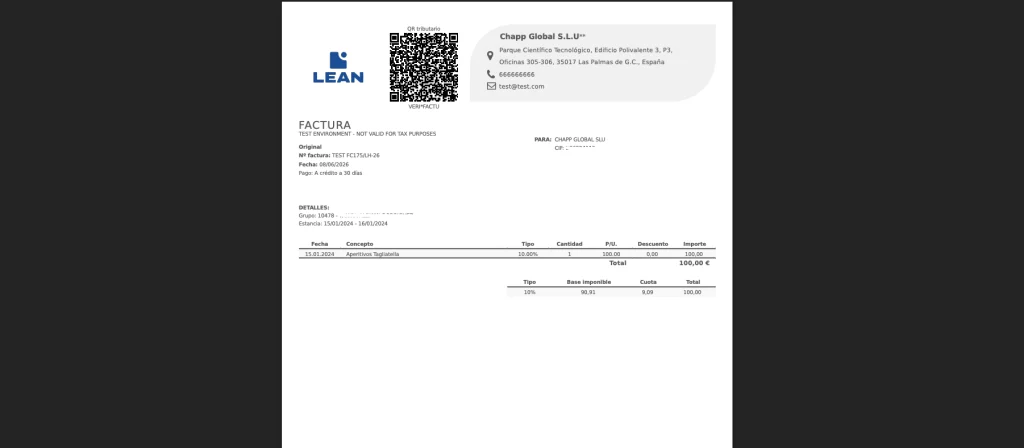
In a hotel, an invoice can document accommodation and other services associated with the stay: breakfast, restaurant, minibar, parking, spa, late check-out, events or any other billable service that is appropriate to include.
In Spain there are full invoices and simplified invoices. The full invoice must include, among other elements, numbering, date of issue, identification of the issuer and recipient where applicable, description of the transactions, taxable amount, tax rate and charged tax.
The reception desk does not need to become a tax department, but it must know how to correctly collect data, check charges and recognise when a request needs to go through administration.
Full invoice vs simplified invoice
They aren't the exact same document.
Spanish regulations permit the issuance of simplified invoices in certain circumstances. As a general rule, they may be issued when the amount does not exceed €400 including VAT and in certain other cases established by the regulations. Some services, including certain hospitality and catering services, have specific rules that allow for simplified invoices up to certain amounts.
The simplified invoice has fewer requirements than the full one, but if the recipient needs to exercise certain tax rights, such as VAT deduction where applicable, additional details must be included such as their tax ID number, address and the charged tax amount separately.
Therefore, in the event of a specific business or tax request, reception should follow the procedure defined by administration instead of assuming that any ticket or receipt is sufficient.
Common scenarios in hotels where the guest requests an invoice
Some common scenarios are:
- Business travel.
- Corporate bookings.
- Stays invoiced to a company.
- Events or groups.
- Extras charged to room.
- Bookings intermediated by agencies.
- Additional services that need to be documented separately.
Here the critical piece of data is to identify from the very beginning who should be listed as the recipient of the invoice and what charges should be included.
A good practice is to request billing details before the check-out peak when the hotel already knows the guest will need an invoice.
What is a proforma invoice and when does it make sense to use it in hotels
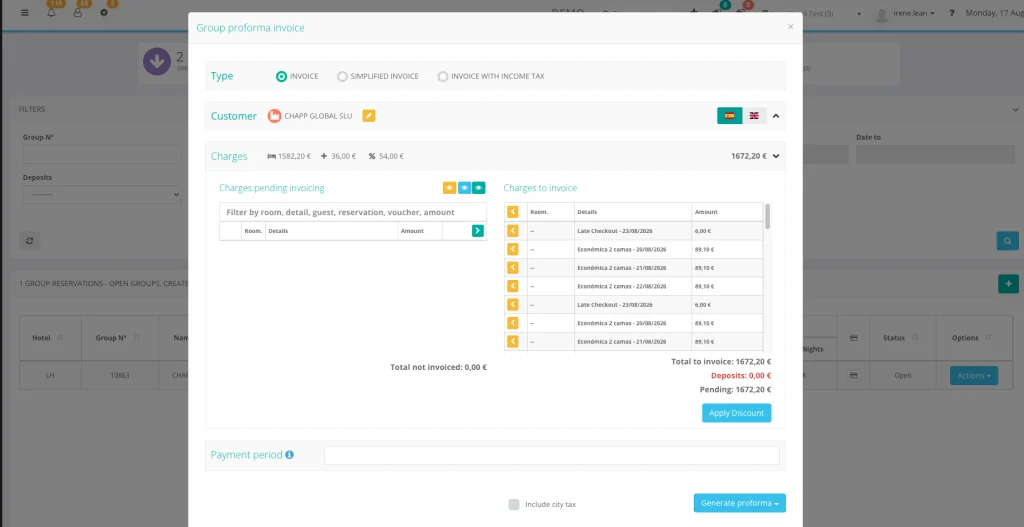
A proforma invoice is a preliminary document that can detail services, prices and conditions before issuing a final invoice.
The Spanish tax authority (AEAT) expressly covers pre-billing systems, drafts or proformas, and makes it clear that a proforma is not yet an officially issued invoice. When it is time to issue an invoice, the proforma must eventually be replaced by the official invoice or simplified invoice.
There is also administrative doctrine published in the BOE that characterises the proforma invoice as an informative or provisional document, distinct from an invoice issued with regulatory requirements and without an equivalent fiscal value to the latter.
In the hotel industry, this is especially useful when amounts or conditions are still pending finalisation.
When to use proforma in hotel bookings
It may make sense, for example, in:
- Groups.
- Companies.
- Events.
- Long stays.
- Reservations requiring internal approval.
- Prior estimates.
- Services pending confirmation.
- Transactions in which the client needs to know the expected amount in advance.
Imagine a company that wants to book ten rooms for four nights. Before authorising the expense, it can request a document with accommodation, breakfast, meeting rooms and other planned services. The proforma invoice allows this estimate to be presented without confusing it with the final invoice.
What a pro forma invoice must not promise
The proforma invoice should not be presented as a final invoice nor used in such a way that the recipient could confuse it with the final tax document.
It must be clearly identified as proforma, draft or preliminary document in accordance with the established procedure.
Furthermore, in the context of computerised billing systems regulated by Spanish legislation, the AEAT points out that pro forma invoices and drafts do not carry the tax QR code corresponding to the definitively issued invoice.
What is a hotel receipt and when to use it
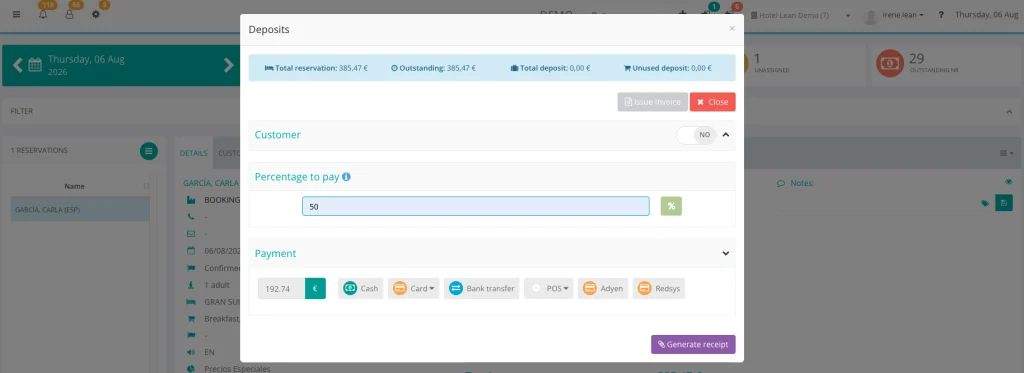
In hotel operations, a receipt is usually used as proof that a certain amount has been received: a payment, a deposit, a token payment or a delivery of money.
The important thing is not to automatically confuse proof of payment with invoice. The fact that a document exists proving that someone has paid does not necessarily mean that this document meets the tax requirements for an invoice or simplified invoice.
Therefore, the internal procedure must clearly differentiate between the recording of the payment and the issuance of the corresponding tax document.
Cases where the receipt may raise doubts
Reception should pay special attention to situations such as:
- Cash payments.
- Booking deposits.
- Deposits or guarantees.
- Part payments.
- Cancelled bookings.
- Pending charges.
- Payments made by a person other than the guest.
- Company that pays for an employee's room.
- Splitting expenses between several guests.
In these cases, it is best to consult the procedure established by administration before improvising a document.
Differences between an invoice, proforma invoice and receipt in hotels
| Document | What is it for? | When it is used | Taxable value | Who usually requests it | Common error |
|---|---|---|---|---|---|
| Invoice | To formally document a transaction | When it is appropriate to invoice for accommodation or services | Yes, when it meets the applicable requirements | Guests, companies, agencies | Issue it with incorrect charges or data |
| Proforma | Anticipating or reporting amounts and conditions | Before finally closing a transaction | It does not replace the official invoice | Companies, groups, events | Treat it as a final invoice |
| Receipt | Verify a payment or delivery of money | Advances, deposits or payments according to operations | It must not be assumed that it is equivalent to an invoice | Guests or payers | Confusing a payment receipt with an invoice |
| Simplified invoice | Document financially certain transactions under the required conditions | In the circumstances permitted by regulations | Yes | Primarily end user | Assuming that any receipt is automatically a simplified invoice |
When to use each document during the guest journey
A simple way to avoid confusion is to relate each document to the stage of the stay.
Before the arrival
Quotes, advance payments or prior payments may appear before the stay.
A pro forma it can be used to present anticipated amounts to companies, agencies, groups or clients who need approval before confirming.
If there is an advance payment, reception must correctly record that amount and follow the invoicing procedure established by administration. The invoicing regulation itself includes the date on which an advance payment was received among the relevant data when it differs from the issue date, so it is not advisable to improvise its tax treatment.
During the stay
During the stay, the main work consists of correctly register the charges:
- Accommodation.
- Breakfast.
- Minibar.
- Parking.
- Restaurant.
- Spa.
- Room service.
- Early or late check-out.
- Other extras.
If the charges are not correctly linked to the corresponding folio, the problem will appear at check-out.
That is why it is not advisable to rush final documents while services or charges can still be added.
At check-out
Check-out is usually one of the critical billing points.
Before issuing the final document, it is advisable to check:
- Accommodation.
- Extras and incidentals.
- Discounts.
- Advances made.
- Payments already recorded.
- Applicable taxes or charges.
- Recipient's tax details.
- Payment method.
- Charges still pending.
Following this review, reception can issue or request the relevant document in accordance with the hotel's administrative procedures.
Frequent errors at reception with invoices, proformas and receipts
Many problems do not stem from tax complexity, but from small operational errors.
Among the most common are:
- Issue a proforma invoice as if it were a final invoice.
- Failing to collect tax data correctly.
- Duplicate documents.
- Forget extras or minibar.
- Mix charges of different guests.
- Do not record advances.
- Issuing an invoice too early.
- Modifying documents issued without following the appropriate procedure.
- Confusing a receipt with a simplified invoice.
- Working with notes external to the PMS.
Prevention involves centralising information and clearly defining who can issue, amend or escalate each document.
Critical error: issuing documents without checking the full folio sequence
Before issuing an invoice or final receipt, the whole page must be checked.
An added minibar five minutes later, a forgotten car park or an undiscounted advance payment can make subsequent corrections necessary. Furthermore, a finally issued invoice should not be treated as a simple editable draft. The AEAT clearly differentiates between the preliminary proforma/draft stage and the officially issued invoice.
The operational rule is simple: review first, then issue.
How a PMS helps to prevent billing errors in hotels
The PMS does not decide which tax treatment corresponds to each transaction and does not replace the accountancy firm. What it can do is reduce a significant portion of errors prior to the issuance of the document.
A PMS like LEAN Hotel System it allows you to manage the reservation, charges, extras, guest information, payments and stay status from a single environment. This helps front desk staff avoid having to piece together the check-out using notes, emails or different tools.
The utility lies in centralisation: before issuing a document, the team can check what has been reserved, what has been consumed, how much has been paid and what remains outstanding.
Data that reception should review before issuing any document
Use this checklist:
- Name on reservation.
- Person or company to whom the document must be issued.
- Tax details when required.
- Room.
- Dates of stay.
- Contracted regime.
- Accommodation invoiced.
- Extras and incidentals.
- Advances.
- Payment method.
- Discounts.
- Taxes or charges.
- Pending charges.
- Payments made by third parties.
- Possible administrative issues.
The objective is for the invoice to be generated from organised information, rather than from reconstructions made while the guest is waiting at the desk.
Final checklist to know which document to issue
- Does the customer need to know the amount in advance or approve an estimate? Assess a proforma invoice clearly identified as a preliminary document.
- Has the customer made a payment and need to credit that remittance? Use the receipt or voucher provided for in the internal procedure, without assuming that it replaces the corresponding tax document.
- Does the transaction need to be documented for tax purposes? The corresponding invoice or simplified invoice must be issued in accordance with applicable regulations.
- Should the invoice be made out in a company name or used for tax purposes? Check that the necessary data has been collected correctly.
- Are there any advances, multiple payers or split charges? Check the transaction with administration before issuing.
- Does the folio still have pending charges? Don't close the final document until you have checked them.
- Are there any questions about which document is the right one? Escalate to administration, management agency or tax consultancy.
Does a proforma invoice have tax validity in a hotel?
Does a receipt count as an invoice?
When must a hotel issue an invoice?
What details to ask for to issue an invoice to a company?
PMS, integrations, automation, data security and tools to digitise the operation.
You might also like Guest experienceDigital check-in, prior communication, personalisation, upselling and in-stay services.
Discover the product PMS integrationsConnect LEAN with distribution, payments, revenue, BI, CRM and other hotel systems.
Related product POK · Digital pre check-inDigitise the check-in process and connect guest data with hotel operations.
Content produced and reviewed by the LEAN editorial team, specialising in hotel PMS, operations, integrations, and guest experience. Last reviewed: 16 June 2026.