


What services to sell before check-in to increase revenue without overwhelming the guest
Selling services before check-in can be a good way to increase ancillary revenue, but only if done thoughtfully. The goal isn't to offer everything to everyone, but to present useful extras at the right time: when the guest is planning their arrival and can still make decisions that will improve their stay.
Pre-stay upselling works best when it resolves a real need: parking, arriving earlier, having breakfast without improvisation, upgrading the room, or booking a service with limited spaces. If it turns into a long list of offers, it can generate friction, abandonment of pre-check-in, or a feeling of aggressive selling.
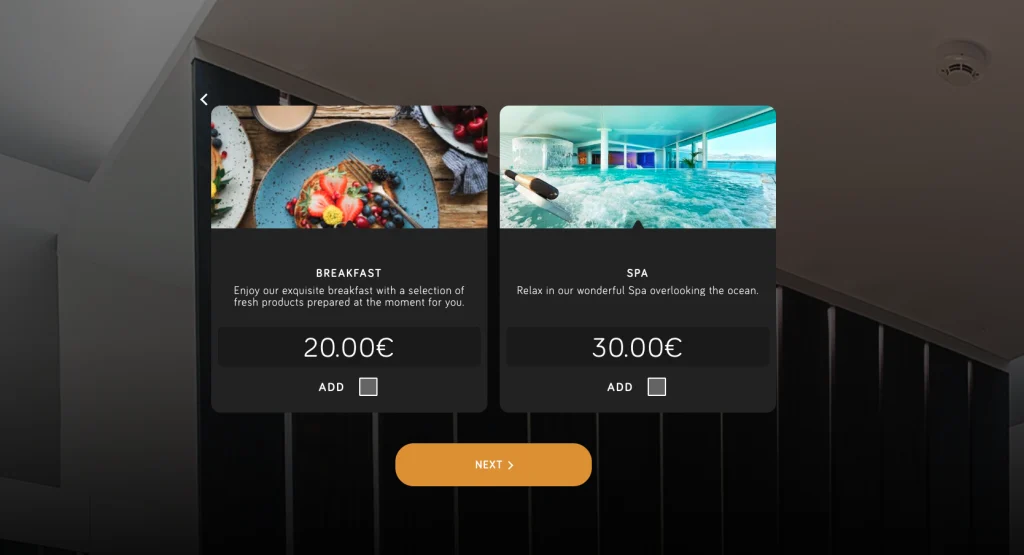
The best time to sell extras isn't always at the reception.
The reception isn't always the best time to offer additional services. When a guest arrives at the hotel, they might be tired, in a hurry, dealing with their luggage, or simply wanting to get to their room. In that context, even a good offer can be perceived as an interruption.
Before arrival, however, the guest is already thinking about their stay: how to get there, what time they can check in, if they'll need parking, if they want breakfast, or if they're interested in a specific experience. That's why certain extras convert better during pre check-in than at the counter. Furthermore, selling beforehand allows for better preparation of the operation: rooms, extra beds, spa bookings, parking spaces, or transfers.
What makes a service a good candidate for selling before check-in
An upgrade is not a good candidate just because the hotel wants to sell it. It must serve a clear purpose within the guest's trip. The best services to offer before check-in they tend to share these characteristics: they improve the stay from the first moment, they are easy to understand, they have limited availability or require preparation, they do not need a long explanation and they fit the booking profile.
The basic filter is this: if the guest can decide it before arriving and that decision helps to better organise their stay, It makes sense to offer it during the pre-stay period. If it requires a lot of explanation, depends on the weather, changes depending on occupancy, or might cause confusion, perhaps it's best to save it for reception or for more contextual communication during the stay.
Rule of thumb: sell sooner the things that help with better arrival planning
The best pre-arrival extras are usually linked to arrival, comfort, and the first few hours of your stay: parking, early check-in, breakfast, transfers, upgrades, or family services. These are services that guests quickly understand and can reduce uncertainty.
For example, A parking space resolves a concern before you even arrive. An early check-in helps with trip planning. An upgrade allows you to calmly decide whether it's worth paying more for space, views, or a terrace.
Services that generally work well before check-in
Not all hotels will have the same extras, but there are services that tend to fit particularly well in the pre check-in phase because they are simple, useful, and easy to prepare.
Early check-in and late check-out
Early check-in and late check-out are closely linked to travel planning. They work well because they meet a clear need: arriving earlier or leaving later without stress. However, they must be communicated precisely.
It is always advisable to indicate whether they are subject to availability, if they have a cost and when they are considered confirmed. An ambiguous phrase like “flexible check-in” can create a false expectation. It is preferable to explain: “early check-in available subject to hotel confirmation and availability”.
Parking space or garage space
Parking is one of the most suitable extras to sell before check-in, especially in urban hotels, destinations with limited parking, or accommodations with a restricted number of spaces. It resolves a significant logistical concern and reduces calls to reception.
Communication must be clear: if it's chargeable, if it requires booking, if there are limited spaces, if it's covered or uncovered, and if there are access conditions. The less uncertainty the guest has, the easier it will be for them to add it to their booking.
Breakfast
Breakfast is an extra that's easy to understand, especially when the booking doesn't include a meal plan. It has an advantage: the guest can decide on it without needing too much explanation.
To present it well, it is advisable to show the price, opening hours, type of breakfast, and relevant conditions, such as child rates, special diets, or the need to book if capacity is limited. There is no need to oversell it with long messages; clearly explaining the value is enough.
Room upgrade
The upgrade works best when presented visually and comparatively. It’s not enough to say “superior room.” The guest needs to understand what they gain: more space, better views, a terrace, amenities, a larger bed, or a quieter location.
It is also important to avoid ambiguous promises. If the upgrade depends on availability, this must be made clear. If the difference is due to a partial view, floor, or category, it is advisable to explain it without exaggerating.
Transfers, transport or pick-up
Transfers are good candidates for city hotels, airports, resorts, or destinations where arrival can be complex. Their value lies in reducing uncertainty: the guest knows who is picking them up, where, and under what conditions.
The price, schedule, meeting point, cancellation conditions, and whether the service is private or shared must be explained. If these details are unclear, the extra may generate more questions than sales.
Family services: cot, extra bed, or children's amenities
Family services help both the guest and the hotel, as they allow rooms to be prepared in advance. Cots, extra beds or amenities for children make sense when the booking profile justifies it.
It is not advisable to offer them to everyone. An individual one-night booking probably doesn't need to see these extras. Instead, for family bookings or long stays, they can add value and avoid last-minute improvisation.
Spa, treatments or activities requiring advance booking
Spas, treatments, guided activities or experiences with limited capacity may be sold before check-in because they require planning. If the guest waits until they arrive, there may no longer be availability.
The key is to clarify whether the service is included, if there's a supplement, if a reserved time slot is required, and what conditions apply. This avoids frustrations like “I thought it was included” or “I didn't know I needed to book.”.
Services best not offered for sale before check-in
Pre-stay upselling shouldn't turn into a full catalogue. Some extras don't work well before arrival because they require too much explanation, are time-dependent or don't fit the guest's profile.
Extras that need too much explanation
Complex packages, experiences with many conditions, weather-dependent services, or products with very uncertain availability can create friction during pre-check-in. If guests need to read too much to understand, they are likely to abandon it or leave it for later.
In these cases, it may be better to offer it at reception, on a tablet with team support, or during the stay when the context is clearer.
Irrelevant services for the booking profile
Offering the same thing to everyone reduces conversion and can be annoying. It doesn't make sense to offer parking to someone who isn't arriving by car, a family package on a corporate individual booking, or a spa to a one-night guest with a late arrival.
Personalisation doesn't have to be complicated. Just use basic signals: booking type, duration, channel, number of guests, room booked, or customer history.
Too many extras at the same time
An oversaturated offer looks like spam. If too many options appear during pre-check-in, the guest might stop completing the main process. It's better to select a few relevant extras and reserve others for in-person check-in or for the stay.
The rule of thumb: fewer extras, better chosen and better explained.
How to customise what services to offer before arrival?
Effective upselling starts by understanding the context of the booking. Sophisticated segmentation isn't necessary from day one, but it is important to use useful data: booking channel, room type, length of stay, likely reason for travel, guest history, and previous spending.
Here, the PMS plays an important role. In LEAN, the guest’s complete history, their previous stays, preferences, and consumption can help anticipate which services are relevant. The goal is not to “force” a sale, but to avoid generic offers.
You can start with very basic segments:
- Business: express check-out, parking, early breakfast or late check-out if applicable.
- Coupleupgrade, spa, dinner, room with a view or special detail.
- Familycot, extra bed, child amenities or parking.
- Long staylaundry, breakfast, parking or recurring services.
- Repeater: extras that they have already purchased or registered preferences.
- Late arrivalinstructions, transfer, light dinner or simplified check-in.
- OTA vs direct: messages and extras adapted according to available information.
The important thing is that each segment sees few extras and that they make sense.
Personalisation should feel helpful, not watchful. If a guest booked parking on a previous stay, you can offer it again discreetly: “Would you like to add parking for this stay?”. There's no need to mention unnecessary details or sensitive data.
Avoid overly personal notes or messages that seem excessively profiled. The right approach is to use the information to save time and improve the stay, not to cause discomfort.
How to automate the offering of extras before check-in without manual labour.
To scale pre-stay upselling, reception shouldn't send offers one by one. The process should be supported by automation and a clear workflow.
POK's Pre-check-in allows you to configure which extras appear during the process, automate sending from the PMS according to the arrival date, and present services in a guided way. This way, the guest can complete their details, review important information, and add relevant services in a single flow, without reception having to manually chase opportunities.
Personalised customer journey by guest type
The tour can be adapted based on profile, type of booking, or identified needs. A family doesn't need to see the same things as a business guest. A returning guest doesn't need the same explanations as someone visiting for the first time.
Customisation helps the guest to perceive the extra as useful, not as a generic promotion.
Visual demonstration of extras: why it matters
The way the extra is presented makes a big difference. Clear photos, brief descriptions, a visible price, and well-explained conditions help to make a decision. This is especially important for upgrades, spa treatments, parking, experiences, or family services.
Avoid long texts and ambiguous promises. The guest should understand in a few seconds what they are buying, how much it costs, and under what conditions.
When to reclaim extras not purchased during pre-check-in
Just because a guest doesn't buy an extra before arriving doesn't mean they've definitively rejected it. They might need context, have questions answered, or want to see the hotel first. That's why it makes sense to recapture some opportunities during in-person check-in.
Here it fits Front Desk AppExtras not converted during pre-check-in can be displayed during check-in on a tablet at reception, without interrupting the welcome or turning the conversation into an aggressive sales pitch. The team can explain only what's relevant and close opportunities with more context.
What extras are worth leaving for the reception?
Some services work best with human support: last-minute upgrades, restaurant recommendations, local experiences, special packages, or services dependent on weather, occupancy, or guest preferences.
The difference lies in the type of decision: if it's simple and logistical, it can go in pre check-in; if it requires explanation or recommendation, it's probably better suited for reception.
How not to overwhelm a guest: fewer extras, better chosen
To avoid friction, it is advisable to apply simple rules: offer few extras per interaction, prioritise utility, explain conditions, avoid repeating the same offer across multiple channels, and do not mix important logistics with lengthy promotions.
The guest should be able to complete pre-check-in without feeling like they are going through a sales funnel. Sales should complement the experience, not interrupt it.
Signs your upselling strategy is generating friction
There are clear signs that it's time to make adjustments: a low click-through rate, abandonment of pre check-in, repeated questions about conditions, complaints about misunderstood costs, or the reception desk having to explain what the message did not.
If it occurs, do not add further messages. Review relevance, clarity and volume of extras.
Metrics for knowing which services to sell before check-in
Pre-check-in upsells should be measured with simple data:
- Conversion by extra.
- Ancillary revenue per booking.
- Pre-check-in completion rate.
- Top-selling extras by segment.
- Enquiries to reception regarding conditions.
- Returns or cancellations of extras.
- Conversion recovered in Front Desk App.
With these metrics, you can decide what to keep, what to remove, and what to move to reception.
Quick plan to define your pre-check-in extras offering
A practical plan would be:
- Review all current hotel extras.
- Choose 5–7 clear candidates for pre-check-in.
- Segment by basic profiles.
- Draft clear and concise terms.
- Configure extras during pre-check-in.
- Measure for 30 days.
- Adjust: remove what is a nuisance, reinforce what converts, and move to reception what needs explanation.
Frequently asked questions about which services to sell before check-in
What extras work best before check-in?
Adaptability allows sales teams to adjust their strategies according to customer trends and preferences. In a changing marketplace, it is vital that the sales team responds quickly to customer expectations, maximising conversion opportunities.
How many extras should I offer at pre-check-in?
The recommended approach is to offer a few, relevant options. Too many choices reduce clarity, can seem like spam, and may cause the process to be abandoned. A good starting point is to select only the extras that improve arrival or require preparation, and leave more complex services for reception or the stay itself.
How do I customise extras based on guest type?
The recommended approach is to offer a few, relevant options. Too many choices reduce clarity, can seem like spam, and may cause the process to be abandoned. A good starting point is to select only the extras that improve arrival or require preparation, and leave more complex services for reception or the stay itself.
Which extras are not advisable to sell before arrival?
It's advisable to avoid complex services with too many conditions, uncertain availability, or little relevance to the booking profile. It's also better not to show irrelevant extras, such as parking for someone not arriving by car, or family packages for an individual corporate booking. Relevance is more important than quantity.
How does pre-check-in help sell extras?
Pre-check-in focuses the offer at a useful moment: the guest is preparing for their arrival and can decide at their leisure. With POK, extras can be displayed visually, guided, and connected to the arrival process, reducing manual workload for reception and avoiding disjointed messages.
What do I do with extras that the guest doesn't buy before arriving?
If they remain relevant, they can be retrieved at reception. For example, via the Front Desk App on a tablet during in-person check-in. This allows the team to explain only what is necessary, resolve doubts, and offer context-dependent extras, without pushing or repeating unnecessary offers.
How do I know if my pre-check-in upsell strategy is working?
If they remain relevant, they can be retrieved at reception. For example, via the Front Desk App on a tablet during in-person check-in. This allows the team to explain only what is necessary, resolve doubts, and offer context-dependent extras, without pushing or repeating unnecessary offers.
You may also be interested in


REQUEST YOUR DEMO TODAY
Discover how Lean Hotel System can transform your hotel business