


«One of the main mistakes is to send the same communication to the entire database. This usually leads to irrelevant messages and ends up reducing the interest of the contacts.»
LEAN Team
Hotel System
specialised in PMS
emerging
Hotel email marketing doesn’t consist of sending a discount to the entire database every few weeks. Its true value lies in maintaining the relationship with people who already know the establishment and using that relationship to generate new direct bookings.
A guest who has already stayed at the hotel knows the location, the rooms, the service, and the experience the hotel offers. Getting them to return doesn’t require starting from scratch. The challenge is identifying when they might have reason to return, what message is relevant to their profile, and how to guide them through a straightforward direct booking process.
Therefore, an effective strategy should follow a clear path: getting to know the guest, segmenting them, sending a relevant campaign, bringing them to the booking engine, and measuring how many bookings and revenue they generate.
Why email marketing is especially useful for driving direct sales
OTAs play an important role in hotel distribution. They help attract demand and allow them to reach guests who may not yet know the establishment. The problem arises when a customer who has already stayed there returns to book again through an intermediary because the hotel has not maintained any direct relationship with them.
The email allows you to stay connected after your stay. The hotel can communicate news, new rooms, services, special periods, benefits of direct booking, or proposals related to the destination without having to re-engage with the same guest from scratch.
It doesn't mean trying to eliminate OTAs, but working better on the customer lifecycle. The OTA can be an excellent initial acquisition channel; email marketing can help ensure that subsequent stays are direct when there is a previous relationship and the conditions allow it.
Before sending campaigns: segment the guest database
One of the fastest ways to reduce the performance of a campaign is to send the same message to the entire audience.
A family that visited the hotel in August does not necessarily have the same interests as a corporate guest who sleeps one night during the week. Nor should a couple who used the spa receive exactly the same campaign as a customer who always reserves parking and arrives for work.
Segmentation can start with very simple criteria:
- Repeat guests.
- Families.
- Couples.
- Business.
- Groups.
- Long stays.
- Geographical origin.
- Regular season visit.
- Booking channel.
- Services previously used.
- Direct booking through an OTA.
It is not necessary to create dozens of segments from day one. It is preferable to work with five or six groups that actually change the content of the campaigns.
How PMS information can help you
Much of the information needed to segment the market already exists within the PMS.
A system like LEAN can centralize the history of stays, the establishments visited within a chain, the type of room used, relevant notes and preferences, or the customer’s categorization.
This allows for the creation of more useful segments than just a list of email addresses.
For example, a chain can identify guests who already know one of its establishments and present them with another hotel in the group. It can also differentiate repeat customers, families, corporate profiles, or guests who have previously used certain services.
The value lies not in storing more data, but in converting operational information into more relevant campaigns, always respecting communication permissions and applicable regulations.
Campaign 1: Get the guest to book directly again
One of the most valuable campaigns is also one of the simplest: re-contacting those who have already stayed.
The message need not be based on a discount. There may be another reason for a return: a new room, an improvement of the hotel, an event in the destination, a new season, services that were not available during the previous stay, or certain advantages associated with direct booking.
The key is to avoid the typical generic “10 % % off if you return” email.
It can be more effective to explain why it’s worth returning and what the guest gets by booking directly: greater flexibility if it really exists, some included services, access to certain extras, or simply a proposal tailored to their interests.
The email should direct the user directly to the booking engine, preferably with easy-to-find dates, rates, or corresponding offers.
Campaign 2: Re-recruiting guests who have not returned for a long time
Not all former guests should receive campaigns with the same frequency.
A reactivation campaign is designed for customers who already know the hotel but have not returned for a reasonable period of time.
Here, the history helps a lot. It’s not the same thing to recover someone who traveled every quarter for work and has not shown up for a year, as it is to recover a family that usually visits the destination every two summers.
Communication can use the new season as context, relevant changes at the establishment, new features at the destination, or services that match the customer profile.
The goal is to remind the guest that the hotel is still an option when they need accommodation again, rather than bombarding them with promotions until they book.
Campaign 3: promotions for periods of low occupancy
The email can also be used as a support tool for revenue.
If the hotel detects certain dates with lower demand, it can identify which segments are more likely to travel during that period and design a specific campaign.
That doesn't mean automatically applying discounts. Sometimes it can be more interesting to keep the price and add value:
- Breakfast.
- Parking.
- Upgrade subject to availability.
- Late check-out.
- Access to some service.
- Exclusive advantage for direct booking.
For example, a getaway during the week could be aimed at geographically close couples, while a campaign for specific working days could make more sense for corporate clients.
The more precise the selection of the audience, the less need there will be to use massive discounts.
Campaign 4: offers based on the type of guest
The information in the database allows for the creation of different campaigns based on the profile.
A family can receive an offer related to school holidays, family rooms or childcare services.
A couple can receive a campaign about getaways, spas, or experiences.
A corporate customer may be more interested in weekday rates, parking, early breakfast, or streamlined check-in procedures.
A repeat guest may receive certain loyalty benefits.
And someone who used the spa during a previous stay may be more inclined to a new wellness experience than a customer who never showed interest in that service.
Personalization doesn’t need to go as far as writing an individual email for each guest. It’s enough to make the message make sense for the group that receives it.
Campaign 5: email after the stay to maintain the relationship
The relationship with the guest should not end when they leave the room.
After the stay, you can send a thank-you note, request a review, provide a survey, or request a testimonial when appropriate. This communication also allows you to keep the relationship open for future campaigns.
However, it is not necessary to try to sell immediately after each check-out.
Sometimes the best post-stay email is simply a good closure of the experience. Later, when there is a relevant reason for a return, that same guest can be part of a repeat, seasonal, or reactivation campaign.
Loyalty works better when each communication has a specific function and not all of them try to close a new sale.
Automates communications without turning them into impersonal messages
An email marketing strategy should not require the team to manually select every day which customers should receive each communication.
Certain messages can be activated automatically based on the reservation, the segment, or the moment of the customer journey.
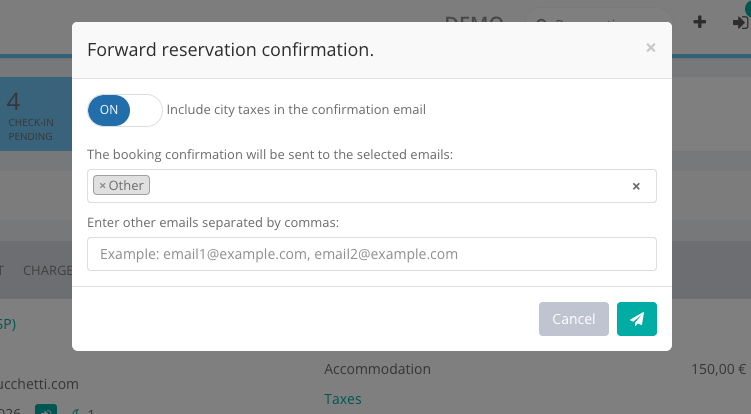
LEAN allows for categorizing customers and working with automations associated with individual bookings and groups, as well as communication processes linked to moments such as pre-check-in.
This allows for reduced manual labor and maintaining a more orderly sequence around the stay.
For deeper marketing strategies — advanced campaigns, complex journeys, specialized email platforms, or more sophisticated analytics — the PMS can be complemented by specific integrations.
What to automate and what should remain a specific campaign
It makes sense to automate predictable and recurring processes:
- Confirmations.
- Communications prior to the stay.
- Pre-check-in.
- Reminders.
- Certain post-stay messages.
- Communications related to a specific type of reservation.
In contrast, other actions should continue to be designed as specific campaigns: low season, openings of new services, events, repeat campaign, important news or actions aimed at specific segments.
Automating everything can make communication lose context. Automation should save time, not replace strategy.
How to get the email to end in a direct booking
A campaign is of little use if it gets clicks but the guest ends up leaving when they try to book.
The email should connect with a simple conversion process.
The subject matter must clearly explain why it is worth opening the message. The content must communicate a specific proposal, use photographs when they really help to understand it, and explain what benefit the guest receives.
There must then be a clear call to action:
Check availability, Book directly, See available dates or an equivalent formula.
That button should lead to the booking engine and not just to the hotel homepage.
In addition, the email offer must match reality. If a certain benefit is advertised, the guest should be able to easily find it when booking. If dates, conditions, or availability are limited, they must be communicated clearly.
The distance between opening the email and completing the reservation should be as short as possible.
Mistakes that make hotel email marketing not work
One of the main mistakes is to send the same communication to the entire database. This usually leads to irrelevant messages and ends up reducing the interest of the contacts.
It is also common to abuse promotions and discounts. If each email offers a lower price, the guest may get used to waiting for the next offer.
Other common errors include using excessive frequency, maintaining databases with duplicate or outdated profiles, not personalizing based on history, sending the user to the main page instead of the booking engine, or measuring only open rates and clicks.
It must also be properly managed who can receive commercial communications and what preferences or permissions exist. Having an email address because someone has stayed at the hotel does not mean that any campaign can be sent without first reviewing the applicable framework.
A good strategy needs commercial relevance and proper data management.
What metrics should be reviewed to know if it is actually generating reservations
The open rate can provide information, but it does not in itself indicate whether a campaign has generated business.
The same thing happens with clicks. An email can receive many clicks and not result in any bookings.
Therefore, it is advisable to prioritize indicators closer to the result:
- Reservations generated.
- Conversion rate to reservation.
- Income per campaign.
- Average value of the reservations.
- Direct reservations by segment.
- Performance of repeat guests.
- Communications outages.
- Campaigns that help to reactivate customers.
In addition, it is advisable to compare segments. Perhaps families spend little on a general campaign, but they respond very well when there is a proposal linked to school holidays. That learning should be used in the following campaigns.
The ultimate goal is not to generate open emails. It is to generate profitable reservations and more lasting relationships.
Checklist for launching a hotel email marketing strategy
To start without complicating the process too much:
- Order the database. Check for incorrect information, outdated profiles, and useless contacts.
- Eliminates or corrects duplicates. A guest should not appear several times with fragmented histories.
- Define basic segments. Repeat guests, families, business travelers, couples, groups, or any profile relevant to the hotel.
- Check permissions and communication preferences. Before activating commercial campaigns.
- Select between three and five initial campaigns. For example, repetition, reactivation, low occupancy, segmentation by profile and post-stay.
- Connects each email with the booking engine. Reduce the steps required to convert.
- It measures reservations and revenue. Do not limit the analysis to openings and clicks.
- Adjust segments and proposals. Keep what works and eliminate campaigns that generate noise without generating business.
A well-maintained simple strategy is often more useful than a calendar full of newsletters without a clear commercial objective.
Which email marketing campaigns work best for hotels?
How does email marketing help you get more direct bookings?
How to segment a hotel's database?
What information from the PMS can be used for email marketing?
PMS, integrations, automation, data security and tools to digitise the operation.
You might also like Guest experienceDigital check-in, prior communication, personalisation, upselling and in-stay services.
Discover the product PMS integrationsConnect LEAN with distribution, payments, revenue, BI, CRM and other hotel systems.
Related product POK · Digital pre check-inDigitise the check-in process and connect guest data with hotel operations.
Content produced and reviewed by the LEAN editorial team, specialising in hotel PMS, operations, integrations, and guest experience. Last reviewed: 16 June 2026.