


«Here fits the relationship between LEAN and POK as a connected ecosystem. The PMS maintains the main reservation information and POK uses that information within the pre-check-in or self-check-in flow."
LEAN Team
Hotel System
specialised in PMS
emerging
Checking in at a hotel no longer has to start with a wait at the front desk. When the property has a well-configured self check-in process, guests can locate their reservation, complete any remaining steps, and obtain their key or access code independently.
This tour can be solved in different ways. With POK, for example, the hotel can work with a self-check-in kiosk inside the establishment or with Virtual Check-in, which allows the process to be carried out directly from your mobile phone in properties compatible with PIN code access.
The key doesn't lie solely in digitalising the check-in. The real objective is to ensure that the reservation, PMS, guest data and access system are connected so that the process can proceed without manual intervention when it's not necessary.
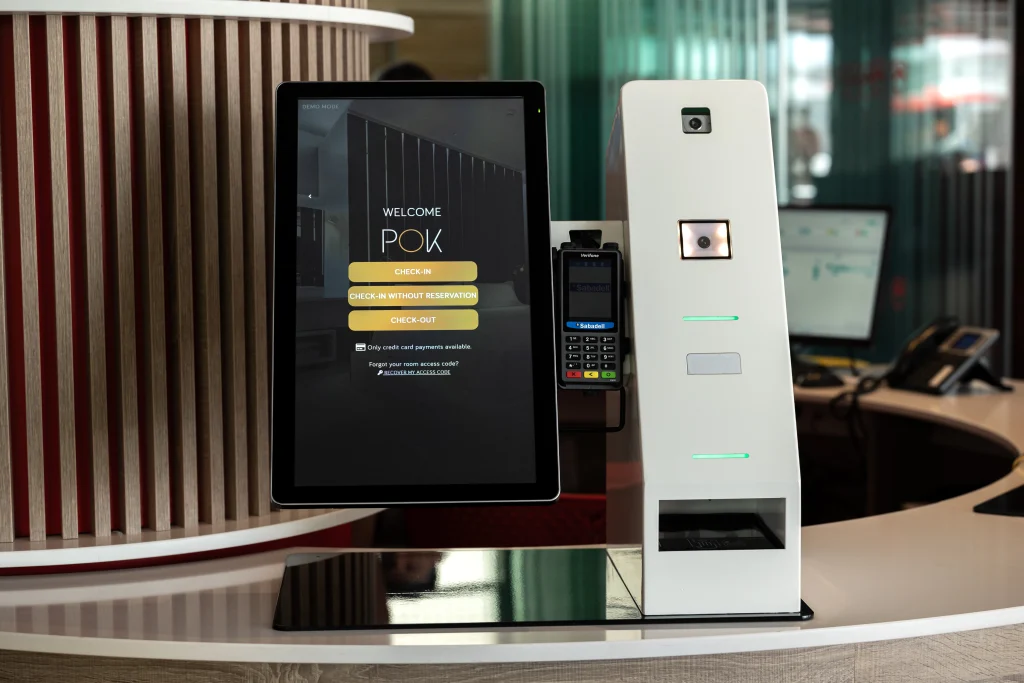
How a hotel check-in works without going to reception
The overall operation can be summarised in a fairly simple process.
When the guest arrives at the establishment, they must be able to locate or identify their reservation. Next, they complete any information that is still pending, validate the steps defined by the hotel and finalise the check-in process.
If there are pending payments, specific conditions or any additional information required, these must also be accounted for within the workflow configured by the establishment.
Once the check-in has been successfully completed, the guest obtains the necessary credential to access the room. Depending on the locking system used by the hotel, this may be a key, a key card or a PIN code.
Not all hotels need the exact same steps. The important thing is that the process can recognise what information is already completed and what is still needed before allowing access.
Self check-in via kiosk: arrive, identify yourself and get access
One of the ways to automate this journey is through a kiosk located in the establishment itself.
The guest arrives at the hotel and uses that terminal to locate their reservation and complete check-in without having to go directly to reception.
POK enables working with this kiosk-based self check-in model, connecting it to the property's operations. The terminal can be used both in properties that work with keys or proximity cards and in hotels where rooms are opened using PIN codes.
Thus, the kiosk does not function solely as a screen for entering data. It forms part of the complete journey from arrival to obtaining access to the room.
Proximity card or PIN code: what the guest receives
The result depends on how the hotel access is configured.
In establishments that use keys or proximity cards, the kiosk can provide the physical credential needed to open the room.
In properties that use PIN code locks, the process may end up providing the guest with the corresponding code.
This is important because self check-in is only truly autonomous if it doesn't force the guest to go to the desk afterwards to get the key.
The flow should be completed within the same process: identification, check-in and access.
Virtual Check-in: check in from your own mobile phone
The second model even eliminates the need to use a physical terminal.
In properties that operate with PIN code access, POK Virtual Check-in allows the guest to complete the process from their own device.
For example, you can scan a QR code upon arrival at the establishment and continue the check-in from your mobile phone. This way, you do not need to use a kiosk or go to the desk to complete your entry.
This model can be especially interesting in holiday apartments, properties with limited reception or establishments where PIN access is already part of normal operations.
From the QR code to the room access
Experience can be understood as a very simple sequence:
Scan QR code → locate or complete the booking → finalise check-in → receive access via PIN → enter the room.
The aim is for the guest not to have to constantly switch between channels or repeat information that the hotel already knows.
If everything is correctly connected and there are no pending exceptions, the process can be carried out from the phone itself until the information needed to open the room is obtained.
If the guest has already done pre-check-in, the process can be reduced to seconds

This is where the combination of pre check-in and self check-in can really simplify arrival.
If the guest has already previously pre check-in, much of the necessary information may be completed before setting foot in the establishment.
This means that, when they arrive, the kiosk or Virtual Check-in does not need to repeat the whole process. They can focus on checking what is still pending, finalising the check-in and providing the access badge.
According to the proposed flow with POK, when the pre-check-in is correctly completed and there are no additional pending steps, the guest can obtain their access and be in their room in approximately 30 seconds.
That time should be understood as a possible scenario under suitable conditions, not as a universal guarantee. If data is missing, there is a pending payment, there is an issue with the reservation or the guest needs assistance, the process will be different.
Pre check-in and auto check-in are not the same
It is advisable to differentiate both concepts because they are often used as if they were equivalent.
The pre check-in it allows information and procedures to be brought forward before arrival. The guest can complete some of the necessary details from home, the airport, or anywhere else.
The automatic check-in, instead, it completes the check-in when the guest arrives at the property and finally allows the access credential to be obtained.
Put simply:
Pre check-in: Prepare the arrival.
Automatic check-in: complete the entry and hand over access.
When both processes are connected, a good deal of the work is already done before the guest arrives.
Kiosk or Virtual Check-in: which option fits each hotel
Both solutions make it possible to reduce the need to go through reception, but they do not address the exact same scenario.
The self-check-in kiosk It is suitable when the hotel wants to have a physical self-service point within the establishment. It can operate with either proximity cards or keys, or with PIN codes, depending on the access system.
The Virtual Check-in it is especially geared towards properties that work with PIN codes and can allow the guest to complete the process from their own mobile phone.
The choice depends on the existing infrastructure, the type of establishment and how you want to organise arrivals.
A hotel with physical cards may need the kiosk to provide the credential. A property with PIN-based locks can offer a much more mobile journey.
What needs to be connected so that guests do not have to go through reception?
The self-service experience doesn't rely solely on installing a kiosk or placing a QR code.
For the route to work properly, several components must be connected:
- Booking.
- PMS.
- Check-in procedure.
- Guest details.
- Room access system.
- Payments, when they form part of the flow.
- Information or documentation still required.
If one of these elements is isolated, a manual step appears.
For example, if the check-in system is unable to correctly identify a booking, the guest will need assistance. If a payment has been made but is not recorded, the process may be held up. If the room has been allocated but the access system does not receive the correct information, check-in cannot be completed either.
Integration is what turns a digital process into a truly autonomous one.
The PMS as the origin of the reservation information
The PMS acts as the hub of this operation.
It must provide details of the booking, the guest, the dates, the allocated room and which steps have already been completed. It must also show what remains to be done before check-in is finalised.
This is where the relationship between LEAN and POK as a connected ecosystem. The PMS maintains the main reservation information and POK uses that information within the pre-check-in or self-check-in flow.
This is how you avoid asking the guest for the same details multiple times or maintaining disconnected parallel processes.
What advantages does this model bring to the guest and the hotel
For the guest, the main advantage is autonomy.
You can avoid queues, complete the check-in process more quickly and gain access to your room without having to wait for a receptionist to finish dealing with another guest. This can be particularly useful after long journeys or when you arrive outside of normal check-in hours.
For the hotel, the benefit appears above all in the management of peaks in activity.
If part of the arrivals can be handled via self check-in, reception has less pressure when many guests arrive at the same time. Repetitive tasks are also reduced and the team can devote more attention to special bookings, issues or customers who genuinely need help.
It is not so much about getting rid of reception as it is about deciding what processes actually need human intervention.
Automating check-in does not mean doing away with human interaction
Not all bookings can always follow a completely autonomous path.
There might be pending documentation, a payment issue, a booking incident, a special requirement or simply a guest who needs assistance.
Therefore, any self-check-in model must anticipate what happens when something does not fit within the standard flow.
The hotel must have a support option that is consistent with its operations: in-person reception, remote support or whatever procedure it has in place for such situations.
Automation works particularly well with predictable processes. Exceptions still need people capable of resolving them.
Checklist before setting up access without going via reception
Before rolling out this model, it is worth reviewing:
- Is the PMS connected to the check-in solution?
- Is the opening system compatible with the proposed workflow?
- Will you be using a self-service kiosk, online check-in or both?
- Do the rooms operate with a key card or a PIN code?
- Is there a pre-check-in process beforehand?
- What information does the guest need to fill in?
- How are pending payments managed, if any exist?
- What happens when some data is missing?
- Can the reservation be correctly recognised?
- Is there a procedure for incidents?
- What assistance alternatives does the guest have?
- Does the team know what to do when the automated workflow cannot be completed?
The ultimate goal is not simply to reduce check-in time. It is to achieve a seamless journey from booking to the room door.
Can you access a hotel room without going through reception?
How does a hotel self-check-in kiosk work?
What is a hotel virtual check-in?
What is the difference between pre check-in and self check-in?
PMS, integrations, automation, data security and tools to digitise the operation.
You might also like
Guest experience
Digital check-in, prior communication, personalisation, upselling and in-stay services.
Discover the product
PMS integrations
Connect LEAN with distribution, payments, revenue, BI, CRM and other hotel systems.
Related product
POK · Digital pre check-in
Digitise the check-in process and connect guest data with hotel operations.
Content produced and reviewed by the LEAN editorial team, specialising in hotel PMS, operations, integrations, and guest experience. Last reviewed: 16 June 2026.